How to Study for MHF4U (Grade 12 Advanced Functions)
Short answer: Practise actively: do full timed tests, mark them honestly, and drill the unit where you lose the most marks. Re-reading notes won't get you through logs or trig identities. Martian Lab has free MHF4U practice tests from 20 years of tutoring YRDSB and TDSB students, with step-by-step solutions for every question.
MHF4U is widely considered one of the toughest courses in Ontario's Grade 12 math lineup. The jump from MCR3U to MHF4U catches many students off guard: the pace is faster, the concepts are more abstract, and the questions require stronger algebraic fluency. Here's how to study for it.
Know What You're Dealing With
MHF4U covers five major areas:
Polynomial functions and equations
Rational functions and asymptotes
Exponential and logarithmic functions
Trigonometric functions in radians, identities, and equations
Rates of change and an introduction to limits
Each unit builds on concepts from MCR3U. If your foundations in Grade 11 Functions are shaky (especially in transformations, exponential functions, or trigonometry), you'll feel it immediately in MHF4U. It's worth going back to review MCR3U concepts you're unsure about before pushing forward.
The Biggest Mistake MHF4U Students Make
Students who coasted through MCR3U with minimal studying often try the same approach in MHF4U and hit a wall. The material in Advanced Functions requires genuine understanding, not just pattern recognition. You can't memorize your way through logarithmic equations or trigonometric identities. You need to understand why the methods work.
The fix is the same as in MCR3U but more important: practice actively. Attempt problems before looking at solutions. Work through full tests under timed conditions. Identify your weakest unit and drill it specifically.
For the final, do the free MHF4U practice exam in one sitting: it mixes questions from every unit, the way the exam will. Keep the MHF4U formula sheet beside you while you review.
Unit-Specific Study Tips
Polynomial Functions
Practice sketching graphs from factored form and identifying end behaviour. Make sure you're comfortable with the factor theorem and long division of polynomials.
Rational Functions
Asymptotes are the key concept. Practice identifying vertical, horizontal, and oblique asymptotes from the equation, and sketching the graph.
Logarithms
Memorize the log laws until they're automatic. Most students lose marks not because they don't understand logs conceptually, but because they make errors applying log properties under pressure.
Trigonometry
MHF4U trig is significantly harder than MCR3U trig. You're working in radians, using identities to simplify and solve equations, and graphing more complex sinusoidal functions. Practice converting between degrees and radians until it's second nature.
Rates of Change
This unit is an introduction to calculus concepts. Focus on understanding the difference between average and instantaneous rate of change, and practice finding limits algebraically.
MHF4U Study FAQ
How do I study for the MHF4U final exam?+
Take a full practice test in one sitting, timed, and mark it honestly. Then drill the units where you lost marks, with the formula sheet beside you. A second full test a few days later shows whether the gaps closed.
Is MHF4U harder than MCR3U?+
Yes. It moves faster, expects your Grade 11 algebra to be automatic, and adds logarithms and radians, which have no Grade 11 version.
Which MHF4U unit is the hardest?+
In Martian Lab's judgment, Exponential and Logarithmic Functions, then Trigonometric Ratios and Rational Functions.
Should I review MCR3U before MHF4U?+
If transformations, exponent laws or trig ratios are shaky, yes. Every MHF4U unit builds on MCR3U, and the gaps show up in the first few weeks.
Where can I find MHF4U practice tests with answers?+
Martian Lab has free MHF4U practice tests from 20 years of tutoring YRDSB and TDSB students, with step-by-step solutions. Each of the 7 units has a free practice test, and the MHF4U practice exam mixes questions from every unit.
Start Preparing Now
Whether your next MHF4U test is next week or your final exam is in June, the best time to start is now. Martian Lab has unit reviews and practice tests for MHF4U: unit reviews that walk you through every concept with detailed, simple explanations before you attempt any questions, followed by carefully curated practice tests from 20 years of tutoring YRDSB and TDSB students, with step-by-step solutions.
7 real questions, one from each unit, straight from the free tests on Martian Lab. Try each one on paper first, then open the answer and mark yourself.
Polynomial Functions
Distinguish, using words, the difference between an odd degree function, an odd order zero, and an odd function. Include examples in your explanation.
Show solution
- odd degree function can be any polynomial function with an odd degree.
- an odd function must be a odd degree function that has a point at the origin and the graph is rotated 180∘ about the origin
- an odd order states the way the graph crosses the x-axis (order 1 is straight through, order 3 is a twist)
Polynomial Equations
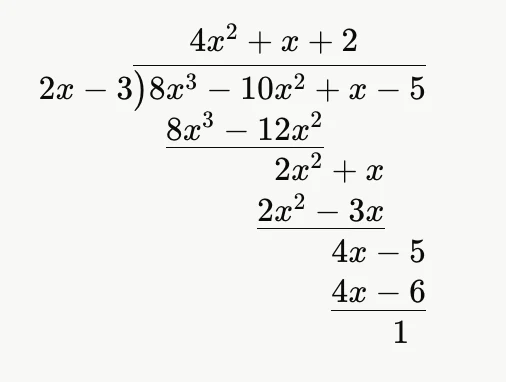
Divide 8x3−10x2+x−5 by 2x−3 then relate 8x3−10x2+x−5 and 2x−3 in two different ways (i.e. using a division statement and using quotient form).
The division statement is:
The quotient form is:
Show solution
See full solution in image below.
The division statement is: 8x3−10x2+x−5=(4x2+x+2)(2x−3)+1
The quotient form is: 2x−38x3−10x2+x−5=4x2+x+2+2x−31
Rational Functions
What is the domain of the function f(x)=5x−112?
Show answer
{x∈R,x=51}
Trigonometric Ratios
State two angles, one negative and one positive, co-terminal to 54π.
Show answer
514π, 5−6π
Trigonometric Functions
A basic sine curve has a minimum y value at intervals of
Show answer
2π
minimum at x=23π+2kπ,k∈Z
Exponential & Logarithmic Functions
Simplify the logarithm logaan
Show answer
n
Combining Functions
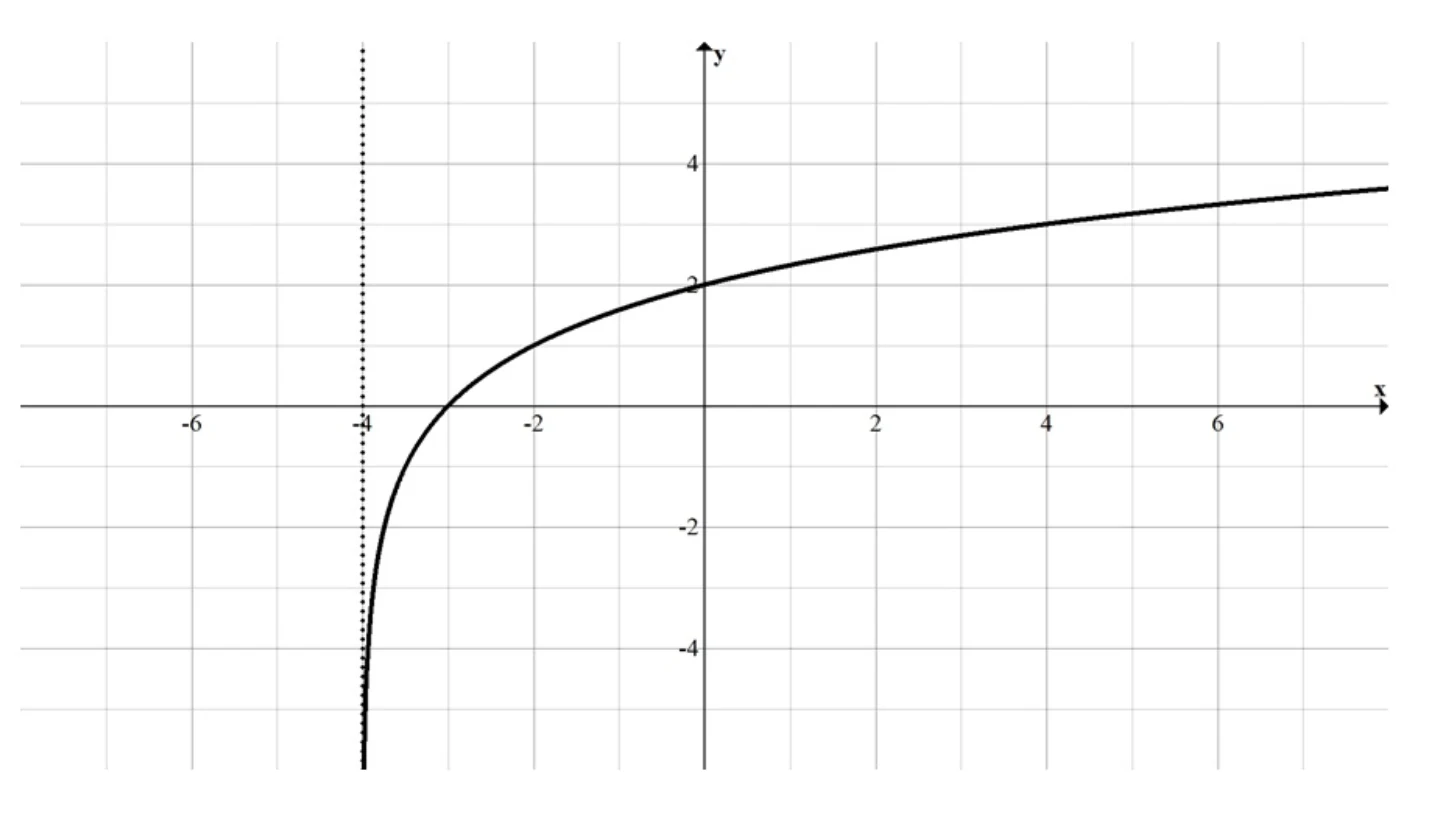
Let f(x)=log2x and g(x)=x+4. Sketch h(x)=(f∘g)(x) and determine its domain and range.