Grade 12 IB Math is live, AA and AI · see the IB course

Grade 12 · MHF4U · Advanced Functions

MHF4U Combining Functions Practice Test (with Solutions)

Combining Functions is about building new functions out of old ones: add them, subtract them, multiply, divide and compose. Your test will hand you functions as equations, sets of ordered pairs and graphs, then ask for the combination, its domain and a word problem or two. Do each part below on paper, then check the answer.

Free Combining Functions Practice Test

8 questions (24 parts), exactly as a free account gets them in the first Combining Functions test on Martian Lab. Try each one on paper first, then open the answer.
  1. Given f(x)=(x−1)2+2f(x) = (x-1)^2 + 2 and g(x)=−x2+2g(x) = -x^2 + 2. Find the equation of the following combine functions. Simplify if appropriate.
    1. f(x)+g(x)f(x) + g(x)
      Show answer
      =x2−2x+1+2−x2+2= x^2 - 2x + 1 + 2 - x^2 + 2 =−2x+5= -2x + 5
    2. g(x)−f(x)g(x) - f(x)
      Show answer
      =−x2+2−x2+2x−1−2= -x^2 + 2 - x^2 + 2x - 1 - 2 =−2x2+2x−1= -2x^2 + 2x - 1
    3. f(x)g(x)f(x)g(x)
      Show answer
      =[(x−1)2+2]⋅(−x2+2)= [(x-1)^2+2]\cdot(-x^2+2)
    4. f(x)g(x)\dfrac{f(x)}{g(x)}
      Show answer
      =x2−2x+3−x2+2= \dfrac{x^2 - 2x + 3}{-x^2 + 2}
    5. f∘gf \circ g
      Show answer
      =f(g(x))= f(g(x)) =[(−x2+2)−1]2+2= [(-x^2+2)-1]^2 + 2
    6. g(f(x))g(f(x))
      Show answer
      =f∘g= f \circ g =−[(x−1)2+2]2+2= -[(x-1)^2+2]^2 + 2
  2. Let f={(−4,−4),(2,4),(1,0),(3,5),(4,6)}f = \{(-4,-4),(2,4),(1,0),(3,5),(4,6)\} and g={(−4,2),(0,2),(1,2),(2,2),(4,4)}g = \{(-4,2),(0,2),(1,2),(2,2),(4,4)\}. Determine each of the following combine functions as a set of ordered pairs if possible.
    1. f+gf + g
      Show answer
      ={(−4,−2),(2,6),(1,2),(4,10)}= \{(-4,-2),(2,6),(1,2),(4,10)\}
    2. f−gf - g
      Show answer
      {(−4,−6),(2,2),(1,−2),(4,2)}\{(-4,-6),(2,2),(1,-2),(4,2)\}
    3. f×gf \times g
      Show answer
      ={(−4,−8),(2,8),(1,0),(4,24)}= \{(-4,-8),(2,8),(1,0),(4,24)\}
    4. g÷fg \div f
      Show answer
      ={(−4,12),(2,12),(4,25)}= \left\{\left(-4,\tfrac{1}{2}\right),\left(2,\tfrac{1}{2}\right),\left(4,\tfrac{2}{5}\right)\right\}
    5. f(g(4))f(g(4))
      Show answer
      =f(4)= f(4) =6= 6
    6. g(f−1(4))g(f^{-1}(4))
      Show answer
      =g(2)= g(2) =2= 2
  3. Let f(x)=x−1f(x) = x - 1 and g(x)=−2x2−5g(x) = -2x^2 - 5, find xx such that f∘g=g∘ff \circ g = g \circ f.
    Show answer
    f∘g=f(g(x))=f(−2x2−5)=(−2x2−5)−1=−2x2−6f \circ g = f(g(x)) = f(-2x^2-5) = (-2x^2-5)-1 = -2x^2-6 g∘f=g(f(x))=g(x−1)=−2(x−1)2−5=−2x2+4x−7g \circ f = g(f(x)) = g(x-1) = -2(x-1)^2 - 5 = -2x^2 + 4x - 7 ∴ −2x2−6=−2x2+4x−7  ,  4x=1,  x=14\therefore\ -2x^2 - 6 = -2x^2 + 4x - 7 \; , \; 4x = 1, \; x = \dfrac{1}{4}
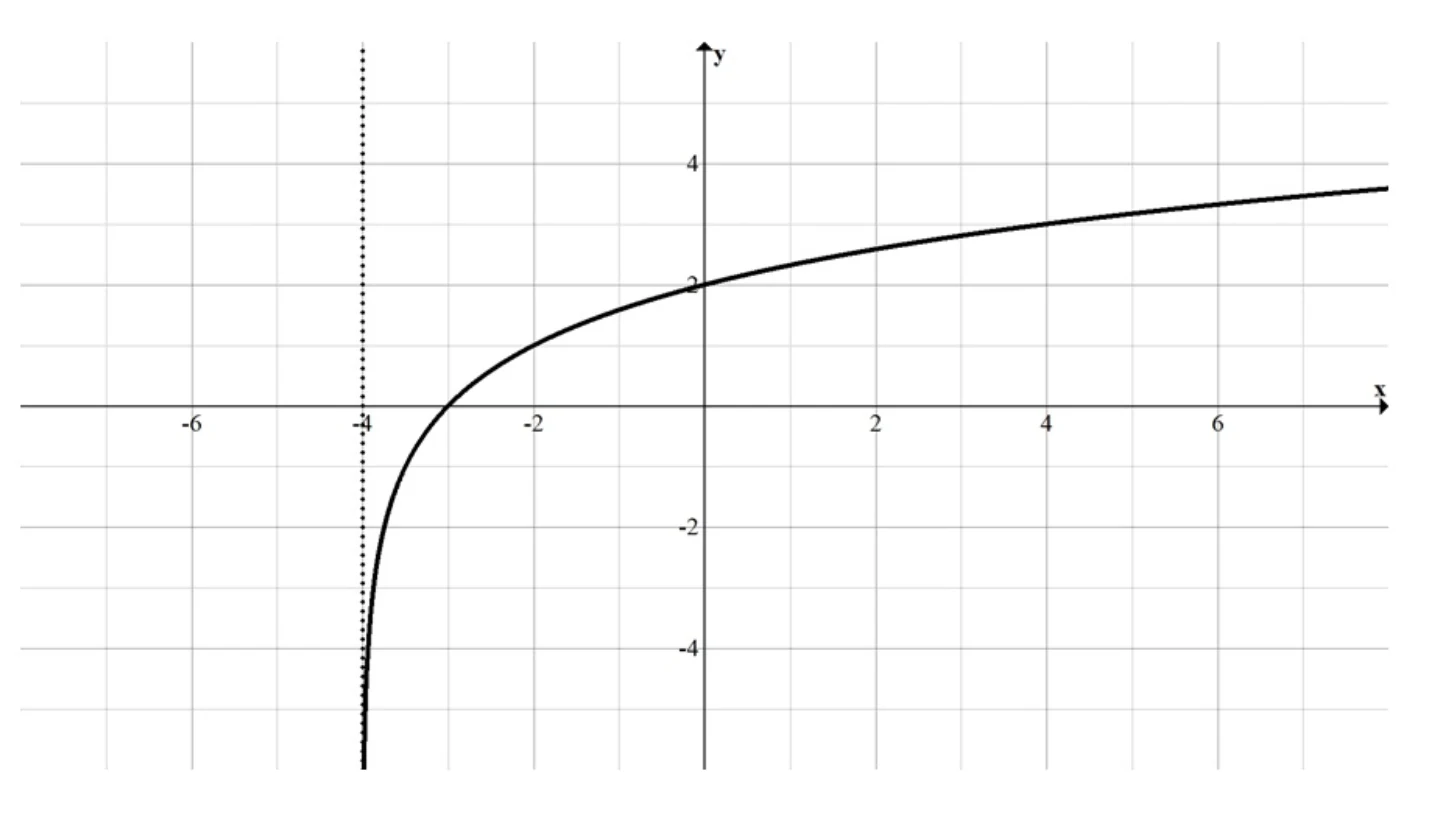
  4. Let f(x)=log⁡2xf(x) = \log_2 x and g(x)=x+4g(x) = x + 4. Sketch h(x)=(f∘g)(x)h(x) = (f \circ g)(x) and determine its domain and range.
    Show solution
    f∘g(x)=f(x+4)=log⁡2(x+4)f \circ g(x) = f(x+4) = \log_2(x+4) D:{x∈R, x>−4}D: \{x \in \mathbb{R},\ x > -4\} R:{y∈R}R: \{y \in \mathbb{R}\}Worked solution
  5. A company produces a toy for $9.45 per unit, plus a fixed operating cost of $52,000. The company sells the toy for $15.80 per unit.
    1. Determine a function, C(x)C(x), to represent the cost of producing xx units.
      Show answer
      C(x)=9.45x+52000C(x) = 9.45x + 52000
    2. Determine a function, I(x)I(x), to represent income from sales of xx units.
      Show answer
      I(x)=15.80xI(x) = 15.80x
    3. Determine a function that represents the profit, P(x)P(x).
      Show answer
      P(x)=I(x)−C(x)=6.35x−52000P(x) = I(x) - C(x) = 6.35x - 52000
    4. How many units must be sold for the company to break even?
      Show answer
      P(x)=0P(x) = 0 6.35x−52000=06.35x - 52000 = 0 x=8188.97x = 8188.97 ∴ 8189\therefore\ 8189 units must be sold.
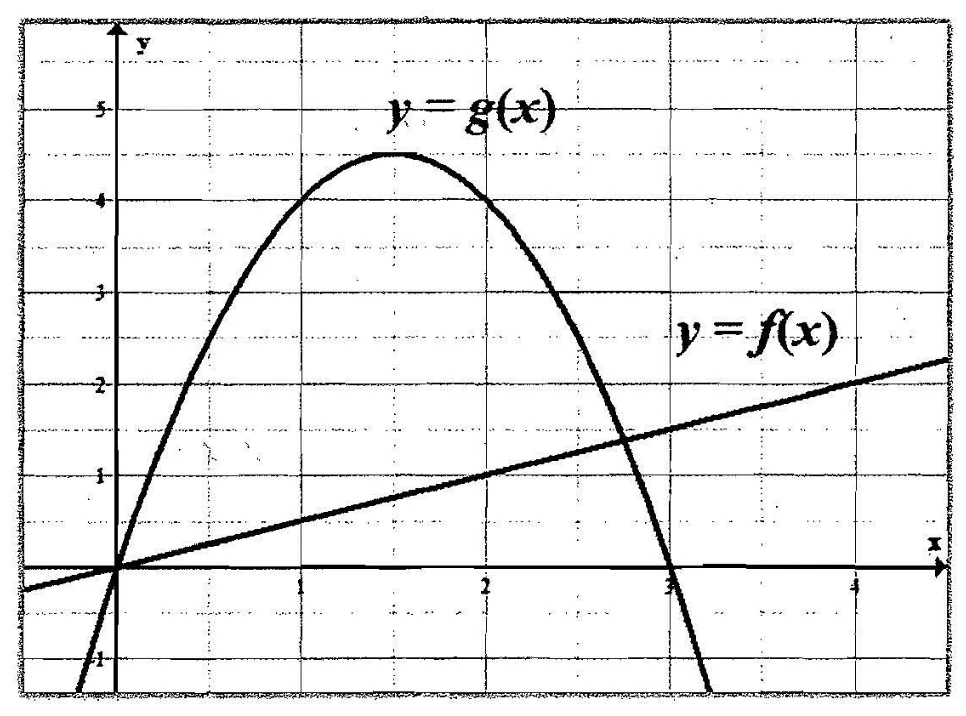
  6. For the functions f(x)f(x) and g(x)g(x) are given in the graph. Find the indicated corresponding function values.
    Figure for the question
    1. (f+g)(1)(f+g)(1)
      Show answer
      (f+g)(1)=0.5+4=4.5(f+g)(1) = 0.5 + 4 = 4.5
    2. (f−g)(2)(f-g)(2)
      Show answer
      (f−g)(2)=1−4=−3(f-g)(2) = 1 - 4 = -3
    3. (f÷g)(0)(f \div g)(0)
      Show answer
      (f÷g)(0)=(f \div g)(0) = undefined
    4. (f×g)(2)(f \times g)(2)
      Show answer
      (f×g)(2)=1×4=4(f \times g)(2) = 1 \times 4 = 4
  7. A spherical weather balloon is being inflated. The radius of the balloon is increasing at the rate of 9 cm per second. Express the surface area of the balloon as a function of time tt (in seconds) and simplify if it is appropriate. Note: Surface area of Sphere =4πr2= 4\pi r^2
    Show answer
    r=9tr = 9t A=4πr2=4π(9t)2=324πt2  (cm2)A = 4\pi r^2 = 4\pi(9t)^2 = 324\pi t^2 \; (\text{cm}^2) ∴\therefore The surface area of the balloon is 324πt2 cm2324\pi t^2\text{ cm}^2.
  8. Let f(x)=mx2+2x+5f(x) = mx^2 + 2x + 5 and g(x)=2x2−nx−2g(x) = 2x^2 - nx - 2. The functions are combined to form the new function h(x)=f(x)÷g(x)h(x) = f(x) \div g(x). Points (1,6)(1,6) and (−1,10)(-1,10) satisfy the new function. Determine the values of mm and nn.
    Show solution
    h(x)=mx2+2x+52x2−nx−2h(x) = \frac{mx^2 + 2x + 5}{2x^2 - nx - 2} h(1)=6  m+7−n=6  ,  m+7=−6nh(1) = 6 \; \dfrac{m+7}{-n} = 6 \; , \; m+7 = -6n h(−1)=10  m+3n=10  ,  m+3=10nh(-1) = 10 \; \dfrac{m+3}{n} = 10 \; , \; m+3 = 10n 4=−16n, n=−144 = -16n,\ n = \dfrac{-1}{4} m=−112m = \dfrac{-11}{2}

This Unit on Martian Lab

The lessons cover the four ways to combine functions, then composition.

  1. Combining Functions
  2. Composition of Functions

Then 4 full Combining Functions practice tests to check yourself.

Start Combining Functions free

Combining Functions FAQ

What is on an MHF4U combining functions test?+

Sums, differences, products and quotients of functions given as equations, ordered pairs and graphs, composite functions like f(g(x)), the domain and range of a combination, and word problems such as profit as income minus cost. The questions on this page cover all of these.

What is the domain of a combined function?+

For f + g, f - g and fg, it is every x where both f and g are defined. For f/g, also remove every x where g(x) = 0. With sets of ordered pairs, only the x values that appear in both sets survive.

Is f(g(x)) the same as g(f(x))?+

Usually not. f(g(x)) puts g inside f, and g(f(x)) does the opposite. For f(x) = x - 1 and g(x) = -2x² - 5, the two composites only agree at x = 1/4.

How do you find the break-even point?+

Write profit as P(x) = I(x) - C(x), set it to 0 and solve. If the answer is not a whole number of units, round up: selling 8188.98 toys does not happen, so you need 8189.

Start Practicing

No credit card required to start.

Get started