Grade 12 IB Math is live, AA and AI · see the IB course

Grade 12 · MHF4U · Advanced Functions

MHF4U Polynomial Functions Practice Test (with Solutions)

Polynomial Functions is all about reading a polynomial: its degree, its leading coefficient, its zeros and what the graph does at each end. Expect questions that hand you a graph or an equation and ask for those features, plus a few that make you build a polynomial from scratch. Do each question below on paper, then check the answer.

Free Polynomial Functions Practice Test

8 questions (13 parts), exactly as a free account gets them in the first Polynomial Functions test on Martian Lab. Try each one on paper first, then open the answer.
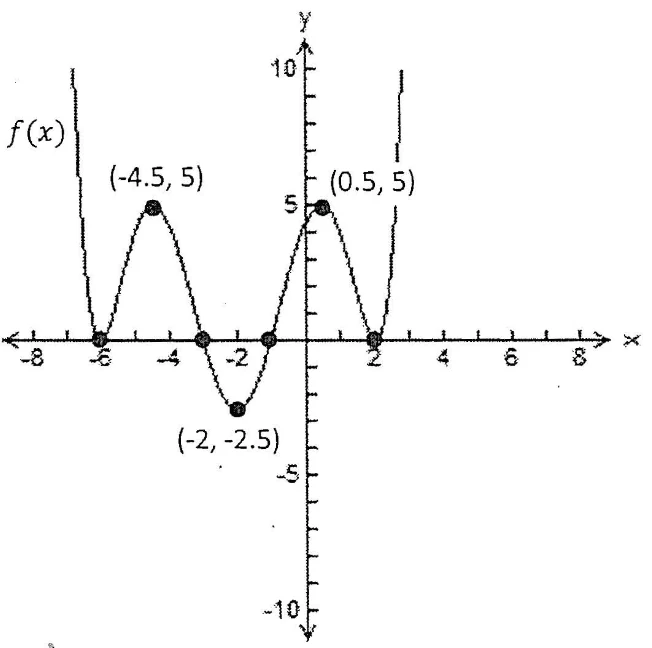
  1. Consider the given graph of f(x)f(x), state the:
    Figure for the question
    1. least possible degree
      Show answer
      6
    2. intervals where f(x)≥0f(x) \geq 0
      Show answer
      x∈(−∞,−3]∪(−1,∞)x \in (-\infty, -3] \cup (-1, \infty)
    3. range, using set notation
      Show answer
      {y∣y∈R,  y≥−2.5}\{y \mid y \in \mathbb{R},\; y \geq -2.5\}
  2. Determine the characteristics of f(x)=(x+5)(4+x)(2x−1)(7−x)f(x) = (x+5)(4+x)(2x-1)(7-x)
    1. value of the leading coefficient
      Show answer
      -2
    2. yy-intercept
      Show answer
      -140
    3. end behaviour: As x→−∞x \to -\infty, y→‾y \to \underline{\phantom{\quad}}. As x→∞x \to \infty, y→‾y \to \underline{\phantom{\quad}}
      Show answer
      As x→−∞x \to -\infty, y→−∞y \to -\infty. As x→∞x \to \infty, y→−∞y \to -\infty
  3. Distinguish, using words, the difference between an odd degree function, an odd order zero, and an odd function. Include examples in your explanation.
    Show solution
    - odd degree function can be any polynomial function with an odd degree. - an odd function must be a odd degree function that has a point at the origin and the graph is rotated 180∘180^\circ about the origin - an odd order states the way the graph crosses the xx-axis (order 1 is straight through, order 3 is a twist)
  4. Describe the transformations that must be applied to y=x5y = x^5 to sketch y=83(−2x+7)5y = \dfrac{8}{3}(-2x+7)^5.
    Show answer
    - vertical stretch by a factor of 83\dfrac{8}{3} - reflection about the yy-axis - horizontal compression by a factor of 12\dfrac{1}{2} - translate right by 3.5 units
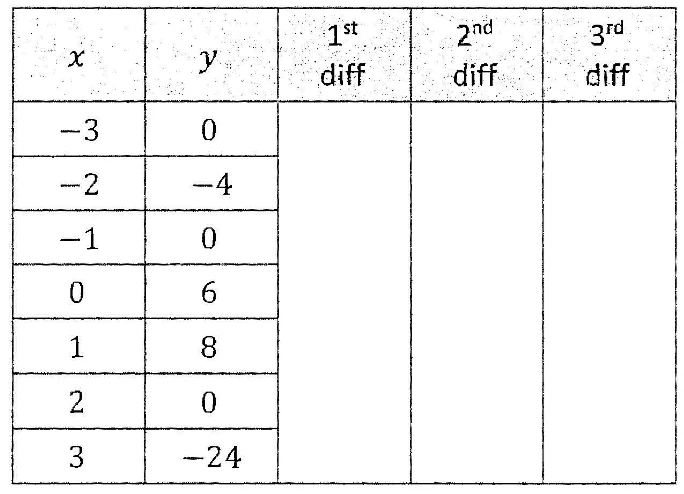
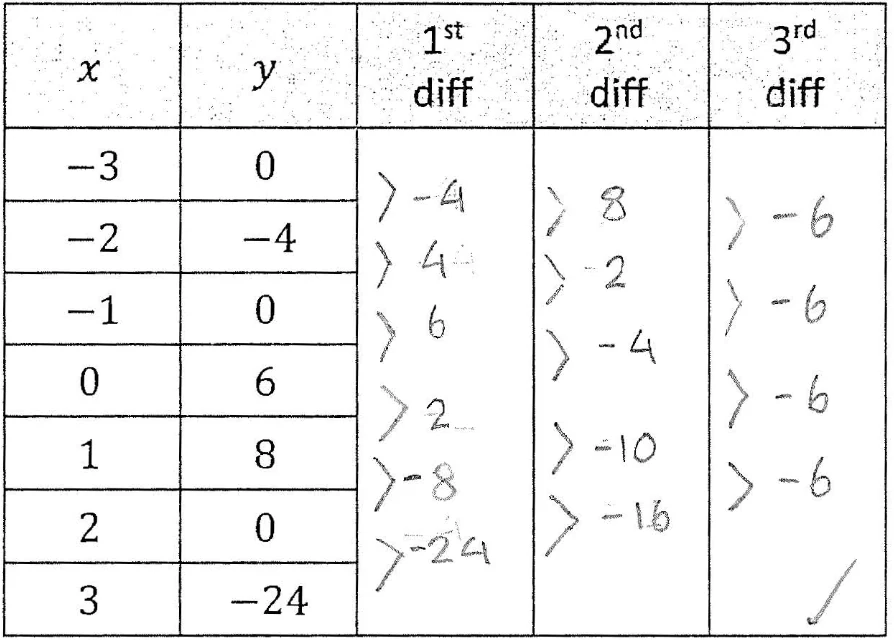
  5. The given table of values represents a polynomial function. Determine an equation for the function.
    Figure for the question
    Show solution
    k=a⋅n!k = a \cdot n! −6=a⋅3!-6 = a \cdot 3! −1=a-1 = a y=−x3+bx2+cx+6y = -x^3 + bx^2 + cx + 6 plug (1, 8): 8=−(1)3+b(1)2+c(1)+68 = -(1)^3 + b(1)^2 + c(1) + 6 8=−1+b+c+68 = -1 + b + c + 6 3=b+c⋯(1)3 = b + c \quad \cdots (1) plug (2, 0): 0=−(2)3+b(2)2+c(2)+60 = -(2)^3 + b(2)^2 + c(2) + 6 0=−8+4b+2c+60 = -8 + 4b + 2c + 6 2=4b+2c⋯(2)2 = 4b + 2c \quad \cdots (2) (2) - (1): 2=4b+2c2 = 4b + 2c −3=b+c-3 = b + c −1=3b+c-1 = 3b + c −1−3b=c⋯(3)-1 - 3b = c \quad \cdots (3) sub (3) into (1): 3=b+(−1−3b)3 = b + (-1 - 3b) 4=−2b4 = -2b −2=b-2 = b sub b into (2): 2=4(−2)+2c2 = 4(-2) + 2c 10=2c10 = 2c 5=c5 = c ∴\therefore the equation is y=−x3−2x2+5x+6y = -x^3 - 2x^2 + 5x + 6Worked solution
  6. Determine whether f(x)=−x(x−3)2+3x(2x−3)f(x) = -x(x-3)^2 + 3x(2x-3) is even, odd, or neither. Justify algebraically.
    Show solution
    f(−x)=−(−x)[(−x)−3]2+3(−x)(2(−x)−3)f(-x) = -(-x)[(-x)-3]^2 + 3(-x)(2(-x)-3) =x(−(x+3))2−3x(−2x−3)= x(-(x+3))^2 - 3x(-2x-3) =x(x+3)2−3x(−2x−3)= x(x+3)^2 - 3x(-2x-3) f(−x)≠f(x)f(-x) \neq f(x) ∴\therefore not even −f(x)=−[−x(x−3)2+3x(2x−3)]-f(x) = -[-x(x-3)^2 + 3x(2x-3)] =x(x−3)2−3x(2x−3)= x(x-3)^2 - 3x(2x-3) f(−x)≠−f(x)f(-x) \neq -f(x) ∴\therefore not odd ∴\therefore the function is neither
  7. Consider the function f(x)=x3+2x2+xf(x) = x^3 + 2x^2 + x.
    1. Identify the xx-intercept(s) of the graph of f(x)f(x).
      Show answer
      x(x2+2x+1)x(x^2 + 2x + 1) =x(x+1)2= x(x+1)^2 x=0,x=−1 (order 2)x = 0, \quad x = -1 \text{ (order 2)}
    2. g(x)g(x) is f(x)f(x) translated 2 units up. Write an equation for g(x)g(x) then determine the xx-intercept(s) of the graph of g(x)g(x).
      Show answer
      g(x)=x3+2x2+x+2g(x) = x^3 + 2x^2 + x + 2 =x2(x+2)+(x+2)= x^2(x+2) + (x+2) =(x+2)(x2+1)= (x+2)(x^2+1) ∴\therefore xx-intercept is x=−2x = -2
  8. Write a polynomial function ff with the following properties. - zeros of 1, 2, 3, each of order 2 - f(x)≤0f(x) \leq 0 for all values of xx - degree of function is 8 Justify why your function is correct with an explanation.
    Show solution
    f(x)=−(x−1)2(x−2)2(x−3)2(x2+3)f(x) = -(x-1)^2(x-2)^2(x-3)^2(x^2+3) - satisfies only having zeroes at 1, 2, 3 with order 2 because (x2+3)(x^2+3) is a complex root; therefore, does not count and doesn't have a real root - satisfies f(x)≤0f(x) \leq 0 for all values of xx because the end behaviour of a negative even degree function is as x→−∞x \to -\infty, y→−∞y \to -\infty and as x→∞x \to \infty, y→−∞y \to -\infty - satisfies degree 8 because −(x)2(x)2(x)2(x2)=−x8-(x)^2(x)^2(x)^2(x^2) = -x^8

This Unit on Martian Lab

The lessons start with power functions and their transformations, then work through sketching, symmetry and rates of change to finite differences.

  1. Polynomials
  2. Transformations of Power Functions
  3. Qualitative Analysis
  4. Sketching Polynomials
  5. Symmetry and Even & Odd Functions
  6. Rate of Change
  7. Finite Differences

Then 4 full Polynomial Functions practice tests to check yourself.

Start Polynomial Functions free

Polynomial Functions FAQ

What is on an MHF4U polynomial functions test?+

Mostly reading polynomials: degree, leading coefficient, end behaviour, zeros and their order, and where the function is positive or negative. You will also see transformations of power functions, even and odd functions, and finite differences. The questions on this page cover all of these.

How do you tell end behaviour from the equation?+

Look at the degree and the sign of the leading coefficient. Even degree: both ends go the same way, up if the leading coefficient is positive and down if it is negative. Odd degree: the ends go opposite ways, rising to the right if the leading coefficient is positive.

How do I check if a function is even or odd?+

Work out f(-x). If it equals f(x), the function is even and symmetric about the y-axis. If it equals -f(x), it is odd and symmetric about the origin. If it is neither, say so and show the algebra.

How do finite differences tell you the degree?+

With x going up by 1 each time, keep taking differences of the y values. If the nth differences are constant, the polynomial has degree n, and its leading coefficient is that constant divided by n!.

Start Practicing

No credit card required to start.

Get started