SCH4U Chemistry
Unit Test: Organic Chemistry
| K | T | C | A | Total |
|---|---|---|---|---|
| /15 | /15 | /10 | /10 | /50 |
Show all your work. Answers without supporting work get part marks at most.
Part A: Knowledge & Understanding
Show solution
Alkynes are hydrocarbons. Their molecules are non-polar and cannot form hydrogen bonds with water, so they have low solubility whatever their size. Small carboxylic acids, amines, amides and ketones all have an oxygen or nitrogen atom that can hydrogen bond with water, so their small members dissolve well.

Show solution
The carbonyl carbon is part of a four-carbon chain, so the parent is butanamide. The nitrogen atom carries two ethyl groups. Groups on the nitrogen of an amide are given the locant N, and two identical groups are combined with di: N,N-diethylbutanamide.
Show solution
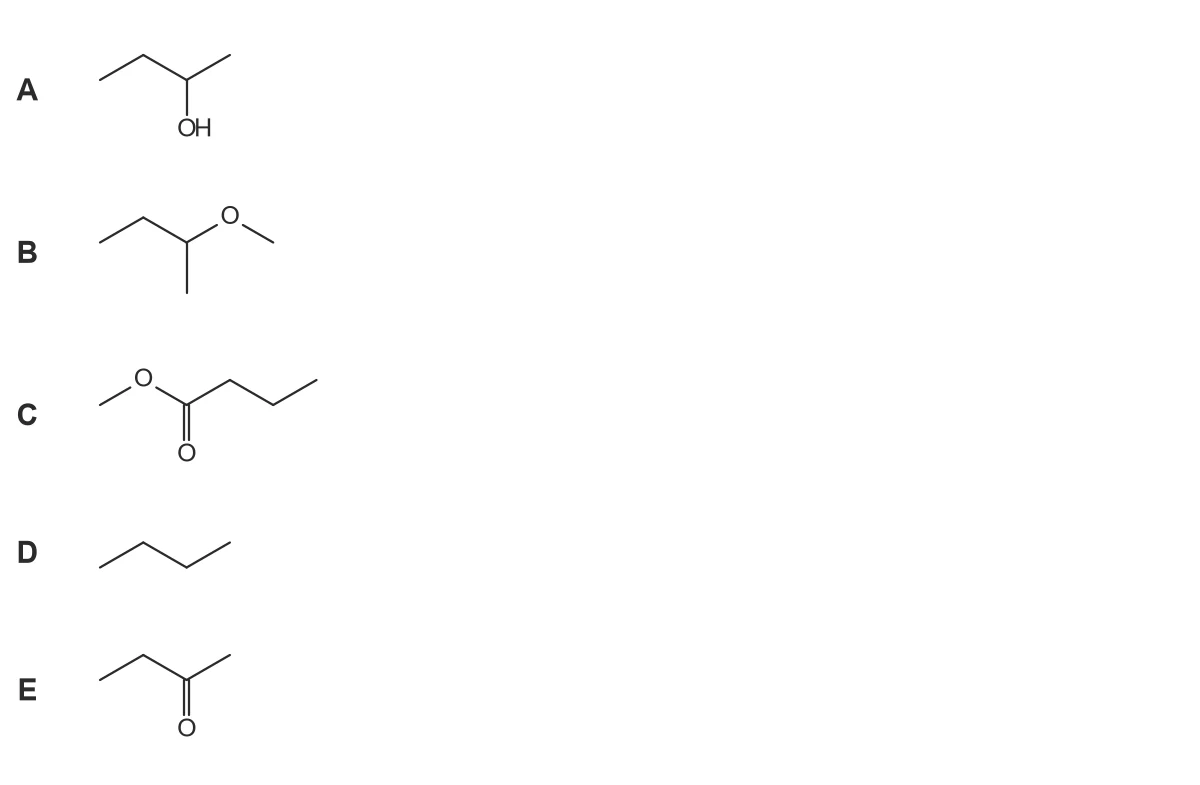
An “active hydrogen” agent is a reducing agent: it adds hydrogen across the carbon to oxygen double bond. The carbonyl carbon of a ketone is bonded to two other carbon atoms, so the alcohol that forms has its hydroxyl group on a carbon with two carbon neighbours. That is a secondary alcohol. Reduction is the reverse of the oxidation of a secondary alcohol to a ketone.