Grade 12 IB Math is live, AA and AI · see the IB course

Grade 11 · MCR3U · Functions

MCR3U Sinusoidal Functions Practice Test (with Solutions)

Sinusoidal functions are sine and cosine graphs, stretched and shifted to model anything that repeats. On Martian Lab the unit is Trigonometric Functions, and its free test has 6 questions: a table of periods, amplitudes and phase shifts, sketches, an equation from a graph and a Ferris wheel. Sketch each graph on paper before you open the solution.

Free Trigonometric Functions Practice Test

6 questions (13 parts), exactly as a free account gets them in the first Trigonometric Functions test on Martian Lab. Try each one on paper first, then open the answer.

  1. Complete the following table.
    FunctionPeriodAmplitudePhase shiftVertical displacementRange
    y=3cos⁡(3x+180∘)−1y = 3\cos(3x + 180^\circ) - 1
    y=sin⁡34(2x+180∘)−1y = \sin\frac{3}{4}(2x + 180^\circ) - 1
    y=13cos⁡ ⁣(4x−90∘2)+3y = \frac{1}{3}\cos\!\left(4x - \frac{90^\circ}{2}\right) + 3
    y=‾cos⁡‾y = \underline{\quad} \cos \underline{\quad\quad}90∘90^\circ12\dfrac{1}{2}−60∘-60^\circ−3-3
    y=‾sin⁡‾y = \underline{\quad} \sin \underline{\quad\quad}720∘720^\circ3360∘60^\circN/A
    Show solution
    FunctionPeriodAmplitudePhase shiftVertical displacementRange
    y=3cos⁡(3x+180∘)−1y = 3\cos(3x + 180^\circ) - 1120∘120^\circ33−60∘-60^\circ−1-1{y∈R−4≤y≤2\left\{\begin{array}{l} y \in \mathbb{R} \\ -4 \leq y \leq 2 \end{array}\right.
    y=sin⁡34(2x+180∘)−1y = \sin\frac{3}{4}(2x + 180^\circ) - 1240∘240^\circ11−90∘-90^\circ−1-1{y∈R−2≤y≤0\left\{\begin{array}{l} y \in \mathbb{R} \\ -2 \leq y \leq 0 \end{array}\right.
    y=13cos⁡ ⁣(4x−90∘2)+3y = \frac{1}{3}\cos\!\left(4x - \frac{90^\circ}{2}\right) + 390∘90^\circ13\dfrac{1}{3}+11.25∘+11.25^\circ+3+3{y∈R83≤y≤103\left\{\begin{array}{l} y \in \mathbb{R} \\ \frac{8}{3} \leq y \leq \frac{10}{3} \end{array}\right.
    y=12cos⁡[2(x+60)]∘−3y = \frac{1}{2}\cos\left[2(x+60)\right]^\circ - 390∘90^\circ12\dfrac{1}{2}−60∘-60^\circ−3-3{y∈R−72≤y≤−52\left\{\begin{array}{l} y \in \mathbb{R} \\ -\frac{7}{2} \leq y \leq -\frac{5}{2} \end{array}\right.
    y=3sin⁡ ⁣[12(x−60)]∘y = 3\sin\!\left[\frac{1}{2}(x-60)\right]^\circ720∘720^\circ3360∘60^\circN/A{y∈R−3≤y≤3\left\{\begin{array}{l} y \in \mathbb{R} \\ -3 \leq y \leq 3 \end{array}\right.
  2. How many x intercepts will the graph of the equation y=−2sin⁡θ−1y = -2\sin\theta - 1 from −360∘≤θ≤360∘-360^\circ \leq \theta \leq 360^\circ?
    Show solution
    0=−2sin⁡θ−10 = -2\sin\theta - 1 1=−2sin⁡θ1 = -2\sin\theta −12=sin⁡θ-\tfrac{1}{2} = \sin\theta ∴ −360∘≤θ≤360∘\therefore\ -360^\circ \leq \theta \leq 360^\circ ∴ θ1=−30∘  θ2=330∘\therefore\ \theta_1 = -30^\circ \; \theta_2 = 330^\circ θ3=210∘  θ4=−150∘\theta_3 = 210^\circ \; \theta_4 = -150^\circ There are 4 x-intercepts.
  3. A Ferris wheel at Charlotte's Amusement Park has a diameter of 18 m18\,\mathrm{m} and travels at a rate of 6 revolutions every 2 min. At the bottom of the ride, the passenger is 2 m2\,\mathrm{m} above the ground.
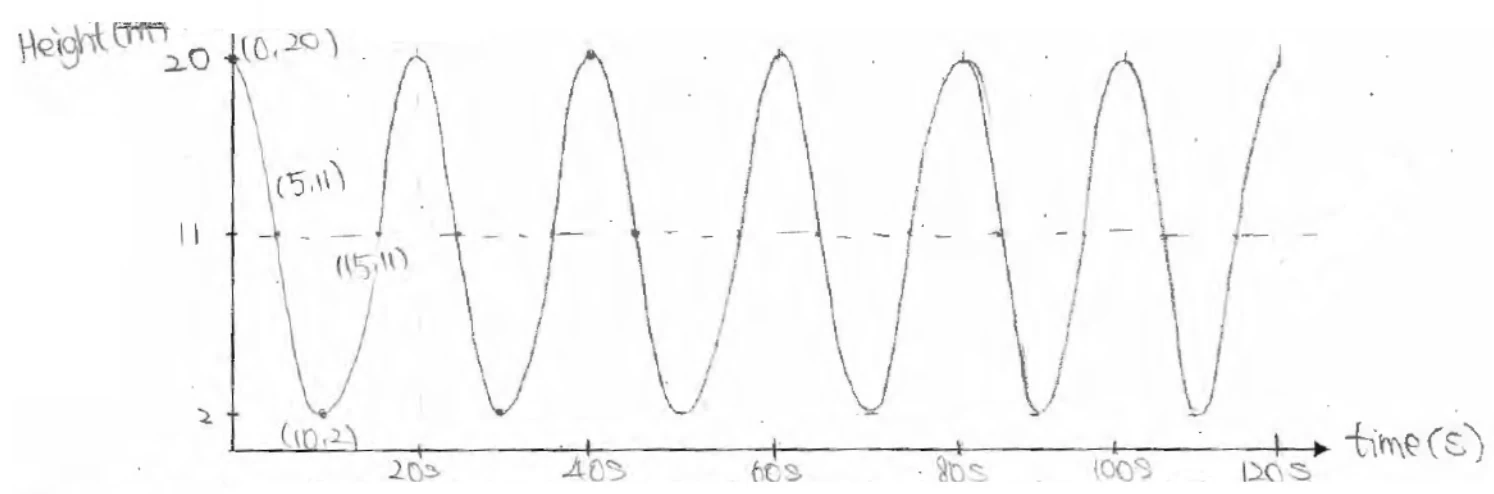
    1. Sketch the graph of the rider's height above the ground, in meters, verses the time, in seconds, for 2 minutes. Assume the rider starts at the highest position at t=0t = 0. Be sure to show the 5 major points of each period, the central axis, and the appropriate labels.
      Show solution
      A correct sketch has amplitude 99, midline h=11h=11, period 20 s20\,\mathrm{s}, and starts at the maximum point. Major points for one period are (0,20)(0,20), (5,11)(5,11), (10,2)(10,2), (15,11)(15,11), (20,20)(20,20). This pattern repeats every 20 s20\,\mathrm{s} for 0≤t≤1200 \leq t \leq 120.Worked solution
    2. Write the equation of the height that represents the height hh above the ground at time tt as a cosine function.
      Show answer
      h(t)=9cos⁡18t+11h(t) = 9\cos 18t + 11
    3. How high above the ground will the rider be at t=78 st = 78\,\mathrm{s}?
      Show solution
      h(78)=9cos⁡18⋅78+11h(78) = 9\cos 18 \cdot 78 + 11 h(78)=18.281152 mh(78) = 18.281152\,\mathrm{m} h(78)≈18.28 mh(78) \approx 18.28\,\mathrm{m} ∴\therefore the rider will be approximately 18.28 m18.28\,\mathrm{m} above the ground at t=78 st=78\,\mathrm{s}.
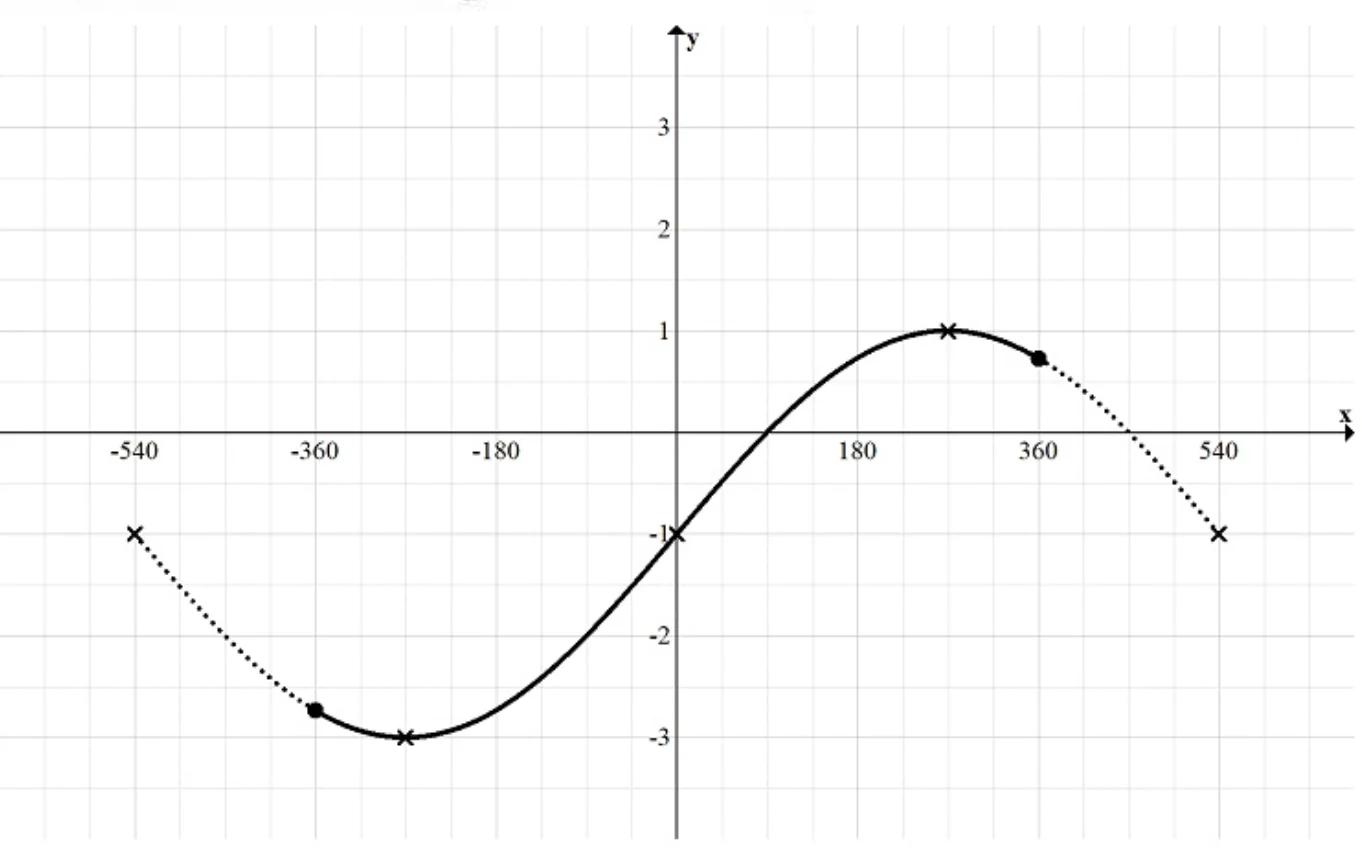
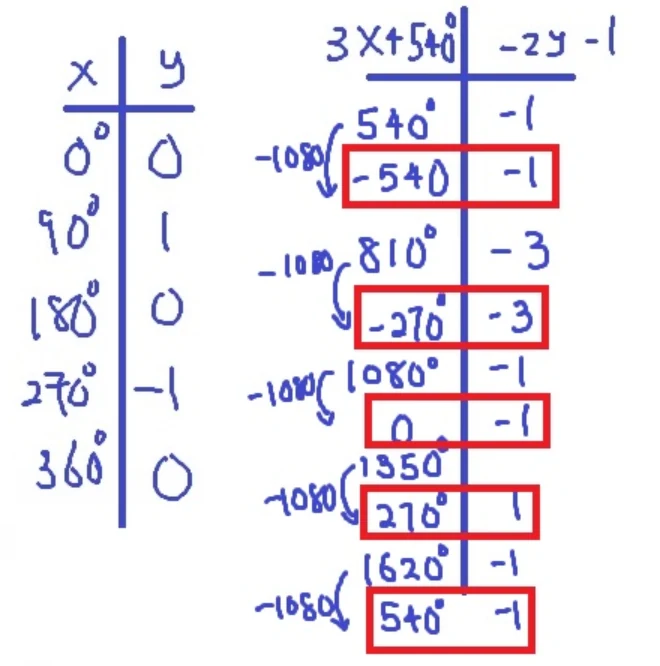
  4. Sketch y=−2sin⁡ ⁣(13x−180∘)−1y = -2\sin\!\left(\dfrac{1}{3}x - 180^\circ\right) - 1 for −360∘≤x≤360∘-360^\circ \leq x \leq 360^\circ
    Show solution
    y=−2sin⁡ ⁣[13(x−540)∘]−1y = -2\sin\!\left[\tfrac{1}{3}(x - 540)^\circ\right] - 1 period =1080∘= 1080^\circ (x,y)→(3x+540∘, −2y−1)(x,y) \rightarrow (3x + 540^\circ,\ -2y - 1)Worked solutionWorked solution
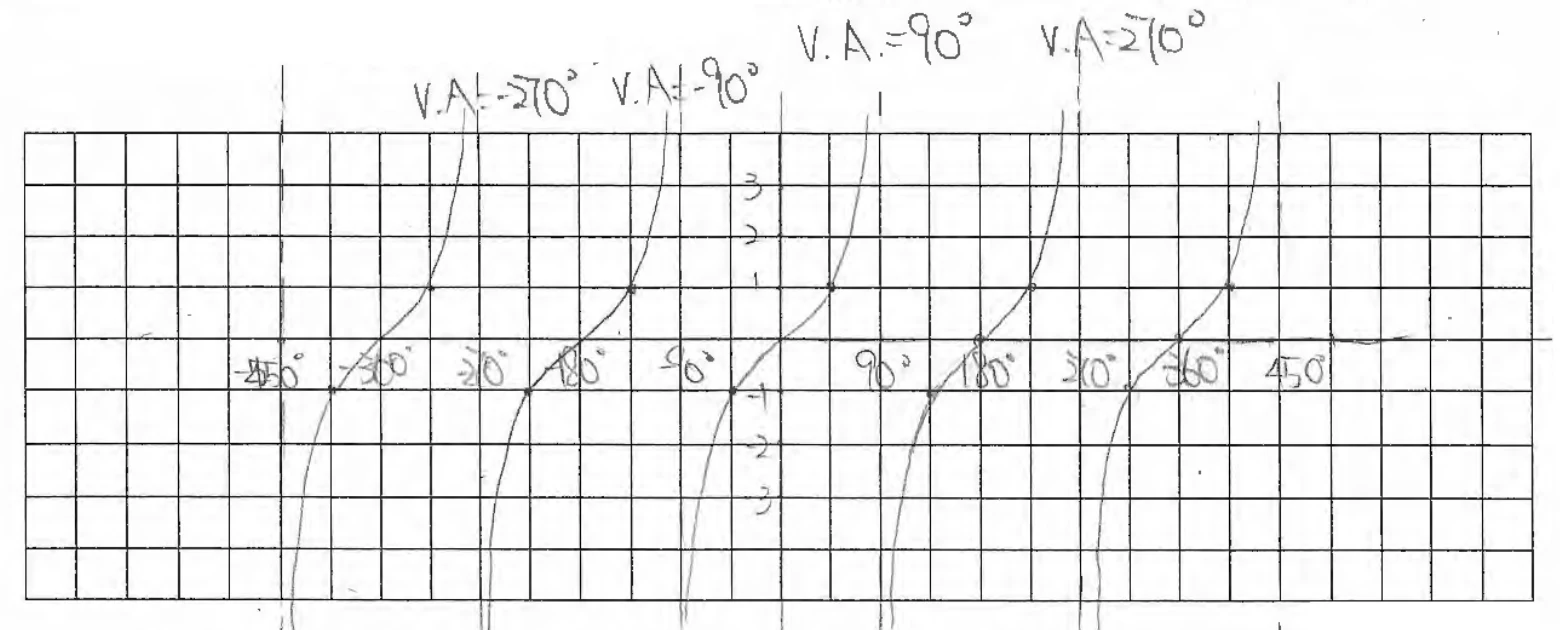
  5. Sketch f(x)=tan⁡xf(x) = \tan x for −360∘≤x≤360∘-360^\circ \leq x \leq 360^\circ and state the domain, range, period, and vertical asymptotes.
    Show solution
    Domain: {x∣x≠±90∘,±270∘, −360∘≤x≤360∘, x∈R}\left\{x \mid x \neq \pm 90^\circ, \pm 270^\circ,\ -360^\circ \leq x \leq 360^\circ,\ x \in \mathbb{R}\right\} Range: {y∣y∈R}\left\{y \mid y \in \mathbb{R}\right\} Period: 180∘180^\circ V.A. =−270∘= -270^\circ V.A. =−90∘= -90^\circ V.A. =90∘= 90^\circ V.A. =270∘= 270^\circWorked solution
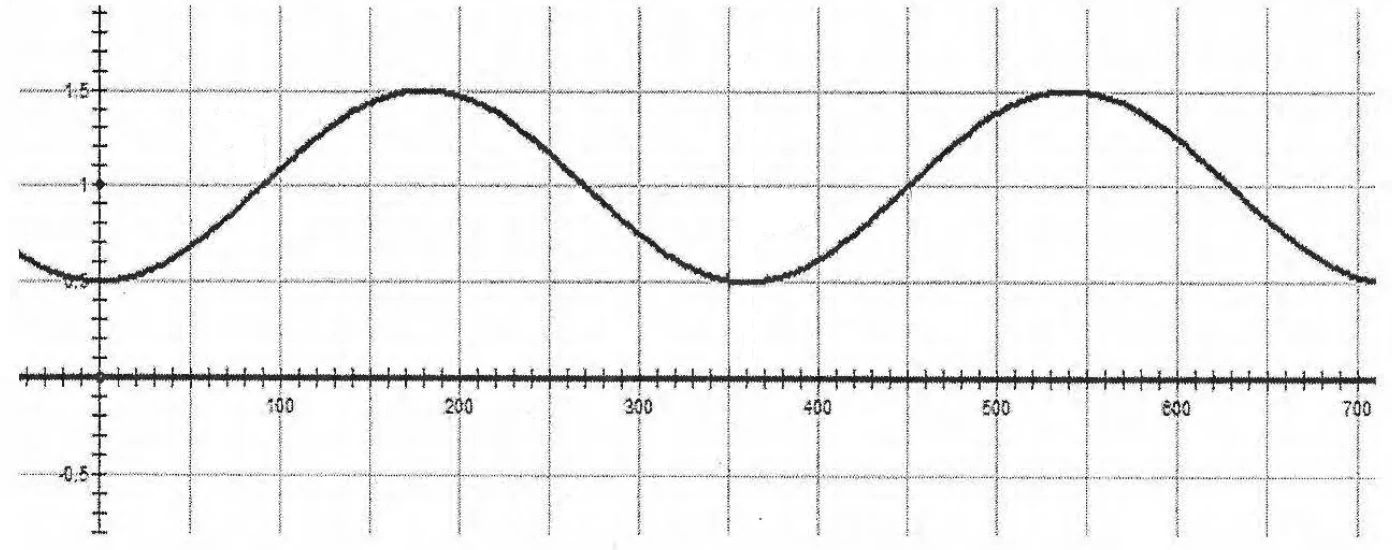
  6. Given the following sinusoidal function, find:
    Figure for the question
    1. Amplitude
      Show answer
      12\dfrac{1}{2}
    2. Period
      Show answer
      360∘360^\circ
    3. Eqn of Axis of Symmetry
      Show answer
      y=1y = 1
    4. k value
      Show answer
      11
    5. Equation for the sine curve
      Show answer
      y=12sin⁡(x−90∘)+1y = \dfrac{1}{2}\sin(x - 90^\circ) + 1
    6. Equation for the consine curve
      Show answer
      y=−12cos⁡x+1y = -\dfrac{1}{2}\cos x + 1

This Unit on Martian Lab

The lessons go from graphing trigonometric functions to writing equations of sinusoidal functions and applying them.

  1. Graphing Trignometric Functions
  2. Equations of Sinusoidal Functions
  3. Applications of Sinusoidal Functions

Then 4 full Trigonometric Functions practice tests to check yourself.

Start Trigonometric Functions free

Trigonometric Functions FAQ

What is on an MCR3U sinusoidal functions test?+

Graphing sine, cosine and tangent, reading amplitude, period, phase shift and vertical displacement, writing an equation from a graph, and word problems like a Ferris wheel. The free questions on this page cover each of these.

How do you find the period and phase shift?+

Write the function as y = a sin[k(x - d)] + c, factoring k out of the bracket first. The period is 360°/k and the phase shift is d. y = 3cos(3x + 180°) - 1 is y = 3cos[3(x + 60°)] - 1, so the period is 120° and the phase shift is 60° left.

How do you write the equation of a sinusoidal graph?+

The amplitude is half the distance from max to min, the axis is halfway between them, and the period is the length of one cycle. A graph with a max of 1.5, a min of 0.5 and a period of 360° has amplitude 1/2 and axis y = 1. Start cosine at a max and sine on the axis going up.

How do you model a Ferris wheel?+

The radius is the amplitude, the height of the hub is the axis and the time for one turn is the period. An 18 m wheel with its bottom 2 m up that turns 3 times a minute gives h(t) = 9cos(18t) + 11 in degrees, starting at the top.

Why does y = tan x have asymptotes?+

tan x = sin x / cos x, so it is undefined wherever cos x = 0: at ±90° and ±270° between -360° and 360°. Its period is 180°, not 360°.
Start Practicing

No credit card required to start.

Get started