Grade 12 IB Math is live, AA and AI · see the IB course

Grade 11 · MCR3U · Functions

MCR3U Trigonometric Ratios Practice Test (with Solutions)

Trigonometric Ratios takes SOH CAH TOA past right triangles to any angle up to 360°. The free test is 8 multiple-choice questions: a 5-12-13 triangle, reciprocal ratios, the related acute angle, principal angles and signs from the CAST rule. Sketch the angle in standard position before you choose.

Free Trigonometric Ratios Practice Test

8 questions, exactly as a free account gets them in the first Trigonometric Ratios test on Martian Lab. Try each one on paper first, then open the answer.
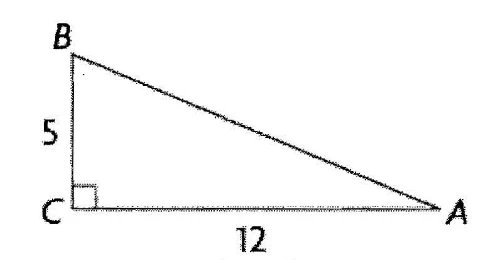
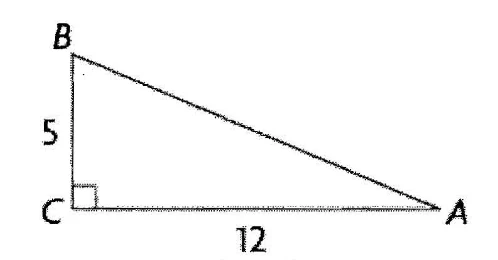
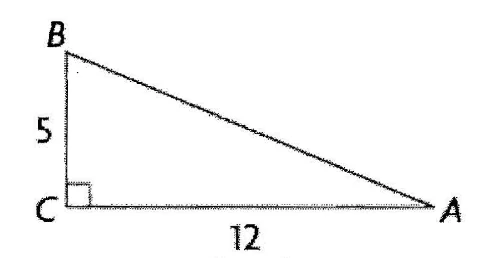
  1. Based on the figure, which of the following represents the length of ABAB?
    Figure for the question
    1. 12
    2. 13
    3. 14
    4. 15
    Show answer
    b) 13
  2. Based on figure 1, which of the following represents the trigonometry ratio of cot⁡(A)\cot(A)?
    Figure for the question
    1. 125\dfrac{12}{5}
    2. 1215\dfrac{12}{15}
    3. 513\dfrac{5}{13}
    4. 1412\dfrac{14}{12}
    Show answer
    a) 125\dfrac{12}{5}
  3. Based on figure 1, which of the following represents the measurement of angle BB to the nearest degree?
    Figure for the question
    1. 23∘23^\circ
    2. 21∘21^\circ
    3. 59∘59^\circ
    4. 67∘67^\circ
    Show answer
    d) 67∘67^\circ
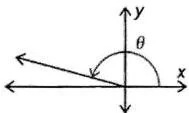
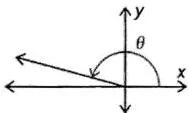
  4. Based on figure 2, which of the following trigonometric ratios has a positive value?
    Angle in standard position with terminal arm in quadrant III
    1. cos⁡θ\cos\theta
    2. sec⁡θ\sec\theta
    3. csc⁡θ\csc\theta
    4. cot⁡θ\cot\theta
    Show answer
    c) csc⁡θ\csc\theta
  5. Based on figure 2, which of the following expression represents the Related Acute Angle (RAA) of θ\theta?
    Angle in standard position with terminal arm in quadrant III
    1. 180+θ180 + \theta
    2. 90+θ90 + \theta
    3. 180−θ180 - \theta
    4. 270−θ270 - \theta
    Show answer
    c) 180−θ180 - \theta
  6. Which of the following is an equivalent principle angle for −216∘-216^\circ?
    1. 36∘36^\circ
    2. 54∘54^\circ
    3. 144∘144^\circ
    4. 126∘126^\circ
    Show answer
    c) 144∘144^\circ
  7. Which of the following has the same numeric value as sin⁡(−40∘)\sin(-40^\circ)?
    1. −sin⁡(40∘)-\sin(40^\circ)
    2. sin⁡(140∘)\sin(140^\circ)
    3. −sin⁡(220∘)-\sin(220^\circ)
    4. −sin⁡(320∘)-\sin(320^\circ)
    Show answer
    a) −sin⁡(40∘)-\sin(40^\circ)
  8. Which of the following represents the exact value of cot⁡(231∘)\cot(231^\circ)?
    1. 0.81
    2. 1.23
    3. −2.32-2.32
    4. −1.23-1.23
    Show answer
    a) 0.81

This Unit on Martian Lab

The lessons cover trigonometry, solving triangles and the ambiguous case, trigonometric identities and 3D problems.

  1. Trigonometry
  2. Solving Triangles & the Ambiguous Case
  3. Trigonometric Identities
  4. 3D Trignometry Problems

Then 4 full Trigonometric Ratios practice tests to check yourself.

Start Trigonometric Ratios free

Trigonometric Ratios FAQ

What is on an MCR3U trigonometric ratios test?+

Primary and reciprocal ratios, angles in standard position, related acute angles and the CAST rule, the sine and cosine laws with the ambiguous case, identities, and 2D and 3D problems. The free questions on this page are on the ratios and angles; the laws and identities are in the lessons.

What are the reciprocal trig ratios?+

csc θ = 1/sin θ, sec θ = 1/cos θ and cot θ = 1/tan θ. In a right triangle cot A is adjacent over opposite, so with legs of 12 and 5, cot A = 12/5.

What is the related acute angle?+

The acute angle between the terminal arm and the x-axis. For θ in quadrant 2 it is 180° - θ, in quadrant 3 it is θ - 180° and in quadrant 4 it is 360° - θ.

How does the CAST rule work?+

It tells you which ratios are positive in each quadrant: all of them in quadrant 1, sine in 2, tangent in 3 and cosine in 4. The reciprocals follow along, so csc is positive wherever sin is.

What is a principal angle?+

The angle between 0° and 360° that ends in the same place. Add or subtract 360° until you land there: -216° + 360° = 144°.

Trigonometric Ratios Topics

One idea at a time: a short explanation, then five worked examples.

Start Practicing

No credit card required to start.

Get started