Determine .
Grade 12 · MCV4U · Calculus & Vectors
MCV4U Rates of Change and Limits Practice Test (with Solutions)
Limits is the base every other calculus unit sits on. Expect to read limits off a graph, handle one-sided limits and piecewise functions, find limits at infinity and say when a limit does not exist. Try each question below before you open the answer.
Free Limits Practice Test
8 questions (17 parts), exactly as a free account gets them in the first Limits test on Martian Lab. Try each one on paper first, then open the answer.
- Determine .
Show answer
- Determine , where .
Show answer
- Determine the value(s) of for which the function has no limit.
Show answer
- Determine .
Show answer
- If then what is ?
Show answer
- Given the graph of , evaluate the following, if possible. If not possible, write undefinted/DNE.
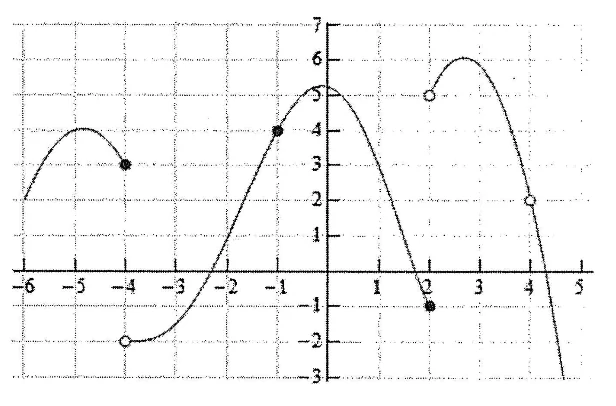
- Given the graph of
Show answer
Show answer
Show answer
DNEShow answer
Show answer
Show answer
Show answer
DNEShow answer
- For each of the following sequences, state the limit or that the limit does not exist.
Show answer
Show answer
DNEShow answer
This Unit on Martian Lab
The lessons start by checking you are ready for calculus, then build from rates of change to limits, limits at infinity and piecewise functions.
- Are WE Ready for Calculus
- Rate of Change
- Limits
- Limits at Infinity
- Piecewise Functions
Then 4 full Limits practice tests to check yourself.
Start Limits freeLimits FAQ
What is on an MCV4U limits test?+
Limits read off a graph, one-sided limits, limits of piecewise functions, limits at infinity, the limits of sequences, and a first look at rates of change. You also need to say when a limit does not exist. The questions on this page cover each of these.
When does a limit not exist?+
A two-sided limit does not exist when the left and right limits disagree, when the function grows without bound near the point, or when it keeps oscillating. If the one-sided limits match, the limit exists even if the function is undefined right at that point.
How do you find a limit at infinity of a rational function?+
Divide the top and bottom by the highest power of x in the denominator. Every term with x left in a denominator goes to 0, and what remains is the limit. When the degrees match, that is the ratio of the leading coefficients.
Is the limit the same as the function's value?+
Not always. The limit is what f(x) approaches near a point, and f(a) is what happens at the point. They only match when the function is continuous there.