Grade 12 IB Math is live, AA and AI · see the IB course

Grade 12 · MHF4U · Advanced Functions

MHF4U Final Exam Review: Free Practice Exam

Your MHF4U final covers all seven units, so your review should too. This practice exam pulls three questions from each unit's free test on Martian Lab, answers included. It is not a past exam paper. It is real practice, in the same style as the unit tests, mixed into one sitting. Then use the checklist to find the units you still need to fix.

Start the practice exam MHF4U formula sheet

Free MHF4U Practice Exam

21 questions, up to 3 from each of the 7 units, taken from the free tests on Martian Lab. Do them in one sitting, on paper, then open the answers.

  1. Polynomial Functions

    Distinguish, using words, the difference between an odd degree function, an odd order zero, and an odd function. Include examples in your explanation.
    Show solution
    - odd degree function can be any polynomial function with an odd degree. - an odd function must be a odd degree function that has a point at the origin and the graph is rotated 180∘180^\circ about the origin - an odd order states the way the graph crosses the xx-axis (order 1 is straight through, order 3 is a twist)
  2. Polynomial Functions

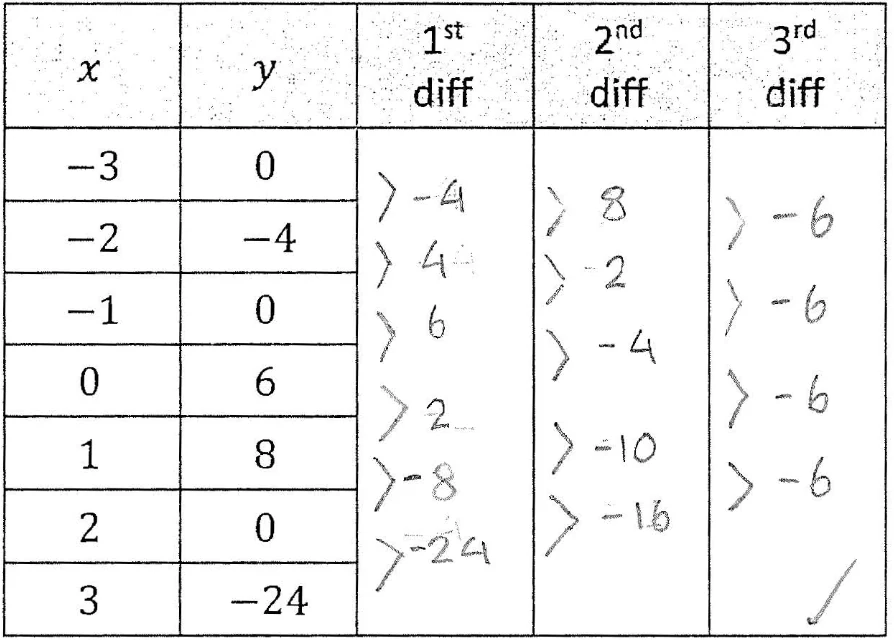
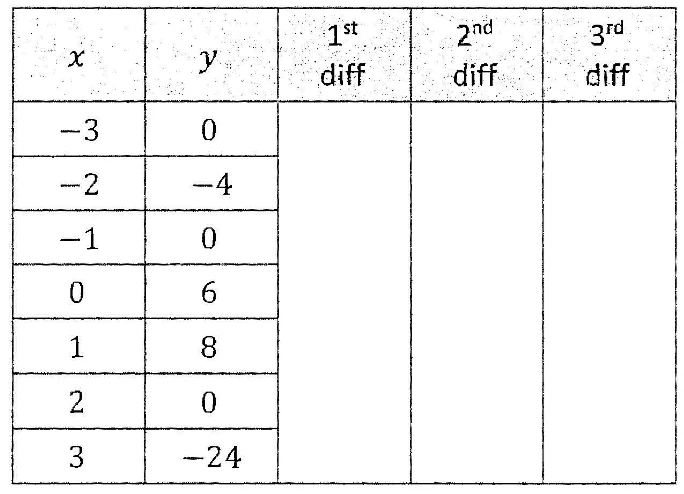
    The given table of values represents a polynomial function. Determine an equation for the function.
    Figure for the question
    Show solution
    k=a⋅n!k = a \cdot n! −6=a⋅3!-6 = a \cdot 3! −1=a-1 = a y=−x3+bx2+cx+6y = -x^3 + bx^2 + cx + 6 plug (1, 8): 8=−(1)3+b(1)2+c(1)+68 = -(1)^3 + b(1)^2 + c(1) + 6 8=−1+b+c+68 = -1 + b + c + 6 3=b+c⋯(1)3 = b + c \quad \cdots (1) plug (2, 0): 0=−(2)3+b(2)2+c(2)+60 = -(2)^3 + b(2)^2 + c(2) + 6 0=−8+4b+2c+60 = -8 + 4b + 2c + 6 2=4b+2c⋯(2)2 = 4b + 2c \quad \cdots (2) (2) - (1): 2=4b+2c2 = 4b + 2c −3=b+c-3 = b + c −1=3b+c-1 = 3b + c −1−3b=c⋯(3)-1 - 3b = c \quad \cdots (3) sub (3) into (1): 3=b+(−1−3b)3 = b + (-1 - 3b) 4=−2b4 = -2b −2=b-2 = b sub b into (2): 2=4(−2)+2c2 = 4(-2) + 2c 10=2c10 = 2c 5=c5 = c ∴\therefore the equation is y=−x3−2x2+5x+6y = -x^3 - 2x^2 + 5x + 6Worked solution
  3. Polynomial Functions

    Determine whether f(x)=−x(x−3)2+3x(2x−3)f(x) = -x(x-3)^2 + 3x(2x-3) is even, odd, or neither. Justify algebraically.
    Show solution
    f(−x)=−(−x)[(−x)−3]2+3(−x)(2(−x)−3)f(-x) = -(-x)[(-x)-3]^2 + 3(-x)(2(-x)-3) =x(−(x+3))2−3x(−2x−3)= x(-(x+3))^2 - 3x(-2x-3) =x(x+3)2−3x(−2x−3)= x(x+3)^2 - 3x(-2x-3) f(−x)≠f(x)f(-x) \neq f(x) ∴\therefore not even −f(x)=−[−x(x−3)2+3x(2x−3)]-f(x) = -[-x(x-3)^2 + 3x(2x-3)] =x(x−3)2−3x(2x−3)= x(x-3)^2 - 3x(2x-3) f(−x)≠−f(x)f(-x) \neq -f(x) ∴\therefore not odd ∴\therefore the function is neither
  4. Polynomial Equations

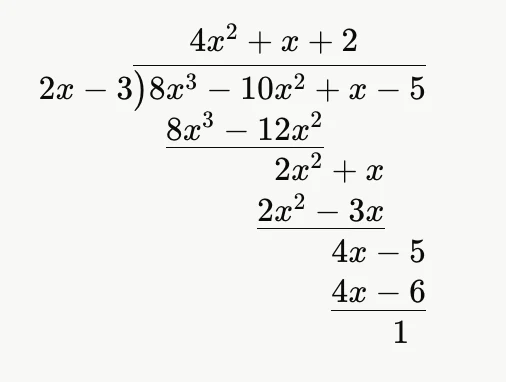
    Divide 8x3−10x2+x−58x^{3} - 10x^{2} + x - 5 by 2x−32x - 3 then relate 8x3−10x2+x−58x^{3} - 10x^{2} + x - 5 and 2x−32x - 3 in two different ways (i.e. using a division statement and using quotient form). The division statement is: \rule{0.5cm}{0.4pt} The quotient form is: \rule{0.5cm}{0.4pt}
    Show solution
    See full solution in image below. The division statement is: 8x3−10x2+x−5=(4x2+x+2)(2x−3)+18x^{3} - 10x^{2} + x - 5=(4x^{2}+x+2)(2x-3)+1 The quotient form is: 8x3−10x2+x−52x−3=4x2+x+2+12x−3\dfrac{8x^{3} - 10x^{2} + x - 5}{2x - 3}=4x^{2}+x+2+\dfrac{1}{2x-3}Worked solution
  5. Polynomial Equations

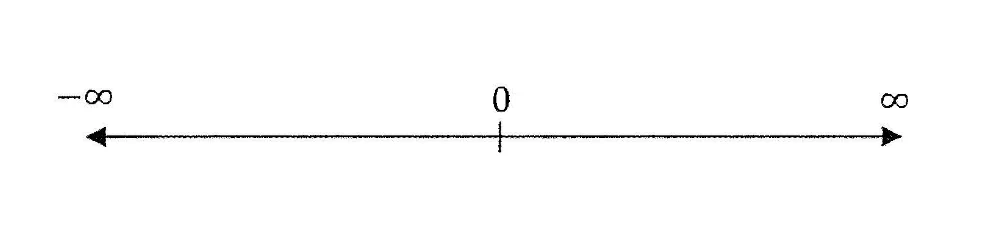
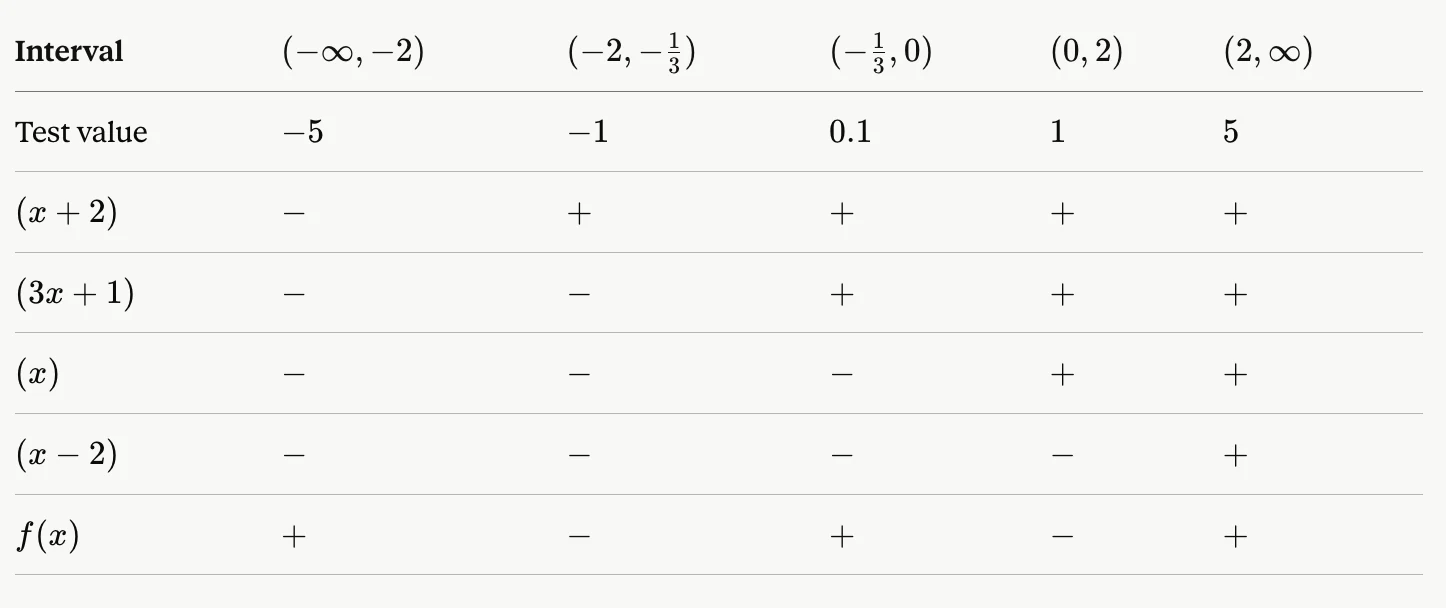
    Solve 3x4+x3−12x2−4x<03x^{4} + x^{3} - 12x^{2} - 4x < 0 for x∈Rx \in R, algebraically. Show your solution using a Real Number Line.
    Figure for the question
    Show solution
    x(3x3+x2−12x−4)<0x(3x^{3}+x^{2}-12x-4)<0 x(x2(3x+1)−4(3x+1))<0x(x^{2}(3x+1)-4(3x+1))<0 x(x2−4)(3x+1)<0x(x^{2}-4)(3x+1)<0 x(x−2)(x+2)(3x+1)<0x(x-2)(x+2)(3x+1)<0 x=0,  2,  −2,  −13x=0,\;2,\;-2,\;-\dfrac{1}{3} ∴  f(x)<0\therefore \; f(x) < 0 when x∈(−2,−13)∪(0,2)x\in\left(-2,-\dfrac{1}{3}\right)\cup(0,2)Real number line with open endpoints at $-2$, $-\frac{1}{3}$, and $2$, and a marked point at $0$Worked solution
  6. Polynomial Equations

    Find the equation of the quartic function in STANDARD FORM, with zeros ±1,2±3\pm 1, 2 \pm \sqrt{3} and passes through the point (2,5)(2, 5).
    Show solution
    f(x)=a(x−1)(x+1)[x−(2+3)][x−(2−3)]f(x)=a(x-1)(x+1)\left[x-(2+\sqrt{3})\right]\left[x-(2-\sqrt{3})\right] =a(x2−1)(x−2−3)(x−2+3)=a(x^{2}-1)(x-2-\sqrt{3})(x-2+\sqrt{3}) =a(x2−1)[(x−2)−3][(x−2)+3]=a(x^{2}-1)\left[(x-2)-\sqrt{3}\right]\left[(x-2)+\sqrt{3}\right] =a(x2−1)[(x−2)2−3]=a(x^{2}-1)\left[(x-2)^{2}-3\right] =a(x2−1)(x2−4x+1)=a(x^{2}-1)(x^{2}-4x+1) =a(x4−4x3+4x−1)=a(x^{4}-4x^{3}+4x-1) 5=a(16−32+8−1)5=a(16-32+8-1) a=−59a=-\dfrac{5}{9} f(x)=−59x4+209x3−209x+59f(x)=-\dfrac{5}{9}x^{4}+\dfrac{20}{9}x^{3}-\dfrac{20}{9}x+\dfrac{5}{9}
  7. Rational Functions

    What is the domain of the function f(x)=125x−1f(x) = \dfrac{12}{5x-1}?
    Show answer
    {x∈R, x≠15}\left\{x \in R,\ x \neq \dfrac{1}{5}\right\}
  8. Rational Functions

    What is the horizontal asymptote of f(x)=6−2x6x−3f(x) = \dfrac{6-2x}{6x-3}?
    Show answer
    y=−13y = \dfrac{-1}{3}
  9. Rational Functions

    What are the zeros of f(x)=(x2−4)(x−1)(x−2)(x+3)f(x) = \dfrac{(x^2-4)(x-1)}{(x-2)(x+3)}?
    Show answer
    x=1,−2x = 1, -2
  10. Trigonometric Ratios

    State two angles, one negative and one positive, co-terminal to 4π5\dfrac{4\pi}{5}.
    Show answer
    14π5\dfrac{14\pi}{5}, −6π5\dfrac{-6\pi}{5}
  11. Trigonometric Ratios

    State an acute angle, in quadrant 1, that is co-related to 7π8\dfrac{7\pi}{8}.
    Show answer
    3π8\dfrac{3\pi}{8}
  12. Trigonometric Ratios

    Convert 680∘680^{\circ} into radians as an exact value (keep as an improper fraction).
    Show answer
    34π9\dfrac{34\pi}{9}
  13. Trigonometric Functions

    A basic sine curve has a minimum yy value at intervals of
    Show answer
    2π2 \pi minimum at x=3π2+2kπ, k∈Zx = \dfrac{3\pi}{2} + 2k\pi,\ k \in \mathbb{Z}
  14. Trigonometric Functions

    The secant curve will have asymptotes at intervals of
    Show answer
    π\pi V.A. x=kπ+π2, k∈Zx = k\pi + \dfrac{\pi}{2},\ k \in \mathbb{Z}
  15. Trigonometric Functions

    The function(s) with zeros at intervals of π2+πn, n∈Z\dfrac{\pi}{2} + \pi n,\ n \in \mathbb{Z} are (full names not abbreviations or write the equations for the functions)
    Show answer
    y=cot⁡xy = \cot x
  16. Exponential & Logarithmic Functions

    Simplify the logarithm log⁡aan\log_a a^n
    Show answer
    nn
  17. Exponential & Logarithmic Functions

    Simplify the logarithm 2log⁡2(3x+4)2^{\log_2(3x+4)}
    Show answer
    3x+43x+4
  18. Exponential & Logarithmic Functions

    The restriction on log⁡2(x+2)+log⁡2(x−2)\log_2(x+2) + \log_2(x-2) is
    Show answer
    x>2x > 2, x∈Rx \in \mathbb{R}
  19. Combining Functions

    Let f(x)=x−1f(x) = x - 1 and g(x)=−2x2−5g(x) = -2x^2 - 5, find xx such that f∘g=g∘ff \circ g = g \circ f.
    Show answer
    f∘g=f(g(x))=f(−2x2−5)=(−2x2−5)−1=−2x2−6f \circ g = f(g(x)) = f(-2x^2-5) = (-2x^2-5)-1 = -2x^2-6 g∘f=g(f(x))=g(x−1)=−2(x−1)2−5=−2x2+4x−7g \circ f = g(f(x)) = g(x-1) = -2(x-1)^2 - 5 = -2x^2 + 4x - 7 ∴ −2x2−6=−2x2+4x−7  ,  4x=1,  x=14\therefore\ -2x^2 - 6 = -2x^2 + 4x - 7 \; , \; 4x = 1, \; x = \dfrac{1}{4}
  20. Combining Functions

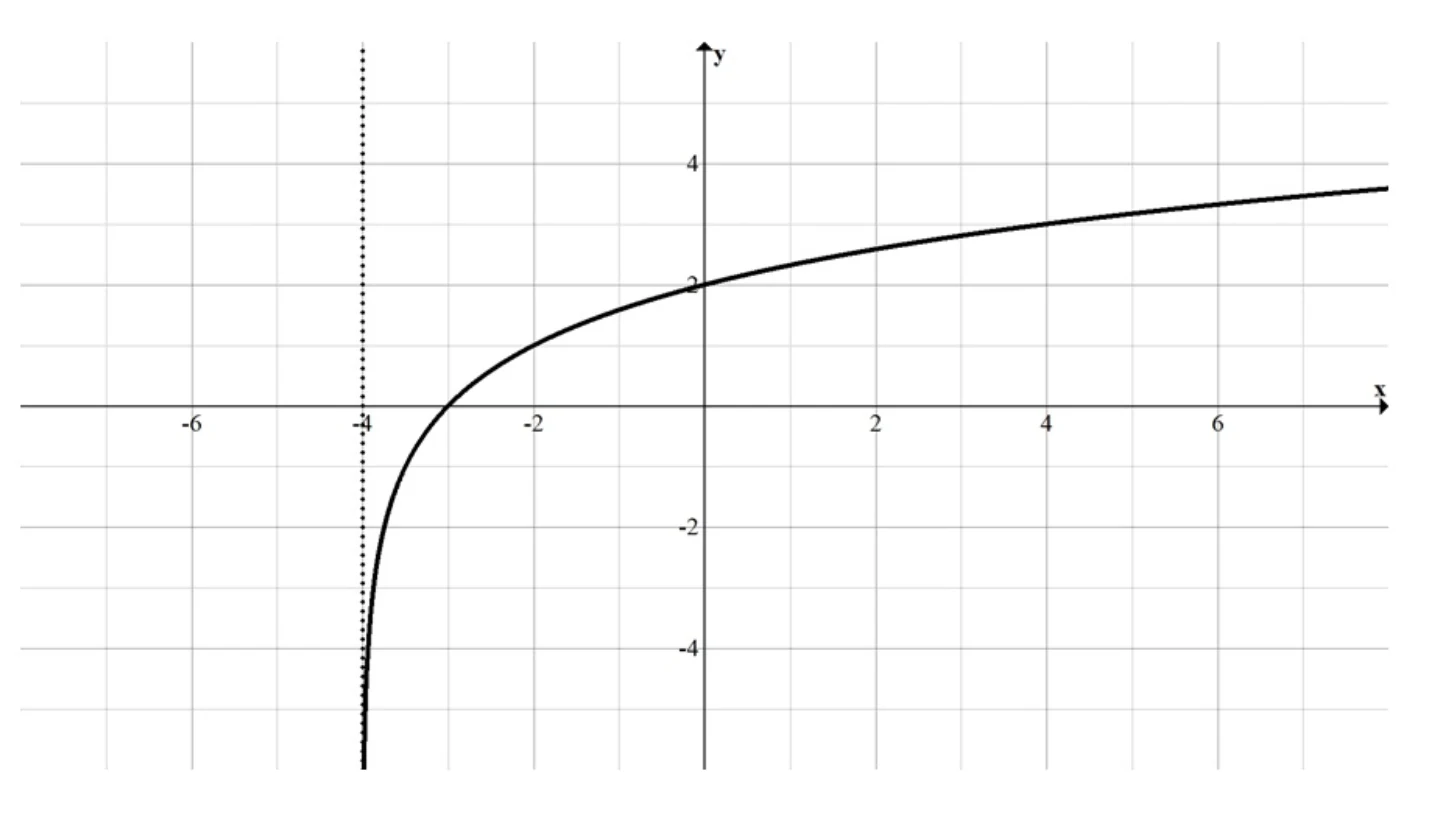
    Let f(x)=log⁡2xf(x) = \log_2 x and g(x)=x+4g(x) = x + 4. Sketch h(x)=(f∘g)(x)h(x) = (f \circ g)(x) and determine its domain and range.
    Show solution
    f∘g(x)=f(x+4)=log⁡2(x+4)f \circ g(x) = f(x+4) = \log_2(x+4) D:{x∈R, x>−4}D: \{x \in \mathbb{R},\ x > -4\} R:{y∈R}R: \{y \in \mathbb{R}\}Worked solution
  21. Combining Functions

    Let f(x)=mx2+2x+5f(x) = mx^2 + 2x + 5 and g(x)=2x2−nx−2g(x) = 2x^2 - nx - 2. The functions are combined to form the new function h(x)=f(x)÷g(x)h(x) = f(x) \div g(x). Points (1,6)(1,6) and (−1,10)(-1,10) satisfy the new function. Determine the values of mm and nn.
    Show solution
    h(x)=mx2+2x+52x2−nx−2h(x) = \frac{mx^2 + 2x + 5}{2x^2 - nx - 2} h(1)=6  m+7−n=6  ,  m+7=−6nh(1) = 6 \; \dfrac{m+7}{-n} = 6 \; , \; m+7 = -6n h(−1)=10  m+3n=10  ,  m+3=10nh(-1) = 10 \; \dfrac{m+3}{n} = 10 \; , \; m+3 = 10n 4=−16n, n=−144 = -16n,\ n = \dfrac{-1}{4} m=−112m = \dfrac{-11}{2}

Unit-by-Unit Checklist

Tick what you can do without notes. Anything you cannot tick, open the unit page and do its full free test.

Polynomial Functions

  • Read degree, leading coefficient and end behaviour off an equation
  • Sketch a polynomial from its factored form, including the order of each zero
  • Tell even and odd functions apart algebraically
  • Use finite differences to find the degree

Polynomial Equations

  • Divide polynomials and write the division statement
  • Use the remainder and factor theorems
  • Factor a cubic or quartic and solve the equation
  • Solve a polynomial inequality with a sign chart

Rational Functions

  • Find vertical and horizontal asymptotes, and tell a hole from an asymptote
  • Graph a reciprocal function from the original
  • Solve rational equations and inequalities

Trigonometric Ratios

  • Convert between radians and degrees
  • Find exact values of special angles on the unit circle
  • Use the co-function, compound angle and double angle formulas
  • Prove a trig identity by working one side at a time

Trigonometric Functions

  • Graph a sinusoid in radians from its equation
  • Write the equation of a sinusoid from a graph or a word problem
  • Solve trig equations on a given interval, including quadratic ones

Exponential & Logarithmic Functions

  • Switch between exponential and logarithmic form
  • Simplify with the log laws, and check the restrictions
  • Solve exponential and log equations, rejecting extraneous roots
  • Use the pH, decibel and Richter formulas

Combining Functions

  • Add, subtract, multiply and divide functions, with their domains
  • Compose functions and find the domain of the composition
  • Decide whether a combined function is even, odd or neither

MHF4U Exam Review FAQ

Is this a real MHF4U final exam?+

No. It is made only of the free questions on Martian Lab: three from each unit's free test, with their answers. The questions come from real Ontario unit tests, so the style is right, but your own final is written by your school.

How should I use this practice exam?+

Do it in one sitting, on paper, without notes. Mark it with the answers, then go to the unit page for every unit where you lost marks. Each one has the full free test for that unit.

What is on the MHF4U final exam?+

All seven units of Advanced Functions: polynomial functions and equations, rational functions, trig ratios and trig functions, exponential and logarithmic functions, and combining functions. Your teacher decides the weighting.

Start Practicing

No credit card required to start.

Get started