November 13, 2026

How to Study for MHF4U Unit Tests

Short answer: find the unit your test covers by topic, take that unit's practice test cold, drill the questions you missed, and retest two days before. Chapter numbers differ by textbook and school, so match the topic, not the number. Martian Lab has free MHF4U practice tests from 20 years of tutoring YRDSB and TDSB students, with a free test in each of the 7 units.

How to study for any MHF4U unit test

  1. Match your chapter to a unit

    Look at the topics on your unit handout, not the chapter number. If your chapter 4 test is on trig identities, that is Trigonometric Ratios here. The 7 units are Polynomial Functions, Polynomial Equations, Rational Functions, Trigonometric Ratios, Trigonometric Functions, Exponential & Logarithmic Functions and Combining Functions. MHF4U units explained maps them to the curriculum.

  2. Take the unit's free test cold

    Before you review anything, do that unit's free practice test on paper with no notes, then mark it. The questions you miss are your study list; the ones you get right need no more time. Each unit page above has its free test, and the hardest MHF4U units post says where students lose the most marks.

  3. Fix each miss at its source

    For every question you missed, find the skill behind it and relearn that, not just the answer. Write the slip down in one line, like a lost sign or a missed restriction, so you spot it next time. Each unit page links topic pages with worked examples, and the MHF4U lessons teach every unit from the start.

  4. Drill until it is automatic

    Do similar questions until you get them right without looking, then mix in questions from earlier units, because MHF4U tests often use them. A short session every day beats one long night. Keep the MHF4U formula sheet beside you at first.

  5. Retest two days before

    Redo the questions you missed, cold, then try the sample test below. Studying for the final instead? Read how to study for MHF4U.

Free MHF4U Sample Test

7 real questions, one from each unit, straight from the free tests on Martian Lab. Try each one on paper first, then open the answer and mark yourself.

  1. Polynomial Functions

    Distinguish, using words, the difference between an odd degree function, an odd order zero, and an odd function. Include examples in your explanation.
    Show solution
    - odd degree function can be any polynomial function with an odd degree. - an odd function must be a odd degree function that has a point at the origin and the graph is rotated 180∘180^\circ about the origin - an odd order states the way the graph crosses the xx-axis (order 1 is straight through, order 3 is a twist)
  2. Polynomial Equations

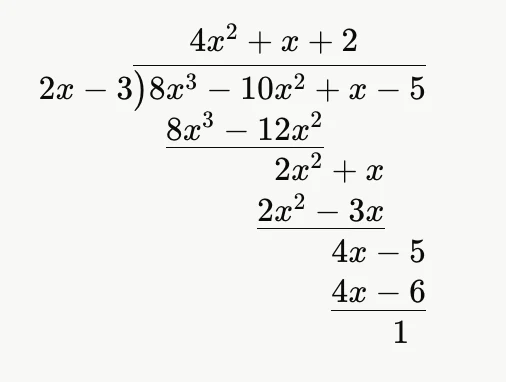
    Divide 8x3−10x2+x−58x^{3} - 10x^{2} + x - 5 by 2x−32x - 3 then relate 8x3−10x2+x−58x^{3} - 10x^{2} + x - 5 and 2x−32x - 3 in two different ways (i.e. using a division statement and using quotient form). The division statement is: \rule{0.5cm}{0.4pt} The quotient form is: \rule{0.5cm}{0.4pt}
    Show solution
    See full solution in image below. The division statement is: 8x3−10x2+x−5=(4x2+x+2)(2x−3)+18x^{3} - 10x^{2} + x - 5=(4x^{2}+x+2)(2x-3)+1 The quotient form is: 8x3−10x2+x−52x−3=4x2+x+2+12x−3\dfrac{8x^{3} - 10x^{2} + x - 5}{2x - 3}=4x^{2}+x+2+\dfrac{1}{2x-3}Worked solution
  3. Rational Functions

    What is the domain of the function f(x)=125x−1f(x) = \dfrac{12}{5x-1}?
    Show answer
    {x∈R, x≠15}\left\{x \in R,\ x \neq \dfrac{1}{5}\right\}
  4. Trigonometric Ratios

    State two angles, one negative and one positive, co-terminal to 4π5\dfrac{4\pi}{5}.
    Show answer
    14π5\dfrac{14\pi}{5}, −6π5\dfrac{-6\pi}{5}
  5. Trigonometric Functions

    A basic sine curve has a minimum yy value at intervals of
    Show answer
    2π2 \pi minimum at x=3π2+2kπ, k∈Zx = \dfrac{3\pi}{2} + 2k\pi,\ k \in \mathbb{Z}
  6. Exponential & Logarithmic Functions

    Simplify the logarithm log⁡aan\log_a a^n
    Show answer
    nn
  7. Combining Functions

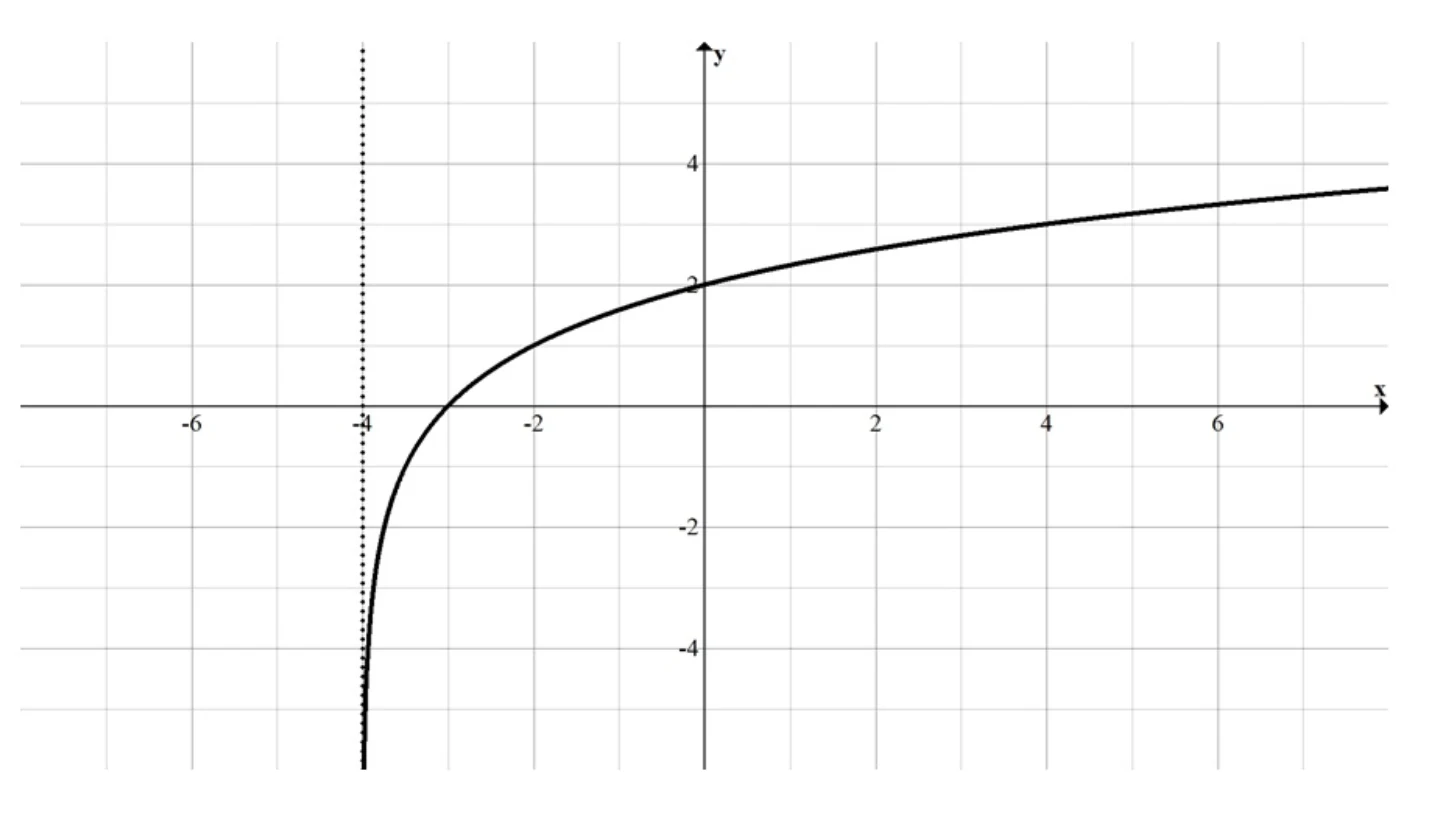
    Let f(x)=log⁡2xf(x) = \log_2 x and g(x)=x+4g(x) = x + 4. Sketch h(x)=(f∘g)(x)h(x) = (f \circ g)(x) and determine its domain and range.
    Show solution
    f∘g(x)=f(x+4)=log⁡2(x+4)f \circ g(x) = f(x+4) = \log_2(x+4) D:{x∈R, x>−4}D: \{x \in \mathbb{R},\ x > -4\} R:{y∈R}R: \{y \in \mathbb{R}\}Worked solution

MHF4U Unit Tests FAQ

How do I study for an MHF4U unit test?+

Take the unit's practice test cold, mark it honestly, relearn the skill behind each question you missed, drill until it is automatic, and retest two days before.

What is on the MHF4U chapter 4 test?+

It depends on your textbook and school, because chapter numbers differ. Check the topics on your unit handout and match them to a unit: trig identities, for example, are in Trigonometric Ratios.

Where do I find an MHF4U absolute value practice test?+

Absolute value is not one of Martian Lab's 7 MHF4U units, and schools place it differently. Check which topic your handout puts it in, then use that unit's practice test.

Which MHF4U unit test is the hardest?+

In Martian Lab's judgment, Exponential and Logarithmic Functions, then Trigonometric Ratios and Rational Functions.

Are there free MHF4U practice tests with answers?+

Yes. Martian Lab has free MHF4U practice tests from 20 years of tutoring YRDSB and TDSB students. The first test in every unit is free, with step-by-step solutions.
Practise every MHF4U unit free

Martian Lab has lessons and practice tests for every MHF4U unit, and the first test in every unit is free. No credit card required.

Get started