Grade 12 IB Math is live, AA and AI · see the IB course

Grade 11 · MCR3U · Functions

MCR3U Final Exam Review: Free Practice Exam

Your MCR3U final covers all seven units, so your review should too. This practice exam pulls three questions from each unit's free test on Martian Lab, answers included. It is not a past exam paper. It is real practice, in the same style as the unit tests, mixed into one sitting. Then use the checklist to find the units you still need to fix.

Start the practice exam MCR3U formula sheet

Free MCR3U Practice Exam

21 questions (23 parts), up to 3 from each of the 7 units, taken from the free tests on Martian Lab. Do them in one sitting, on paper, then open the answers.

  1. Functions & Transformations

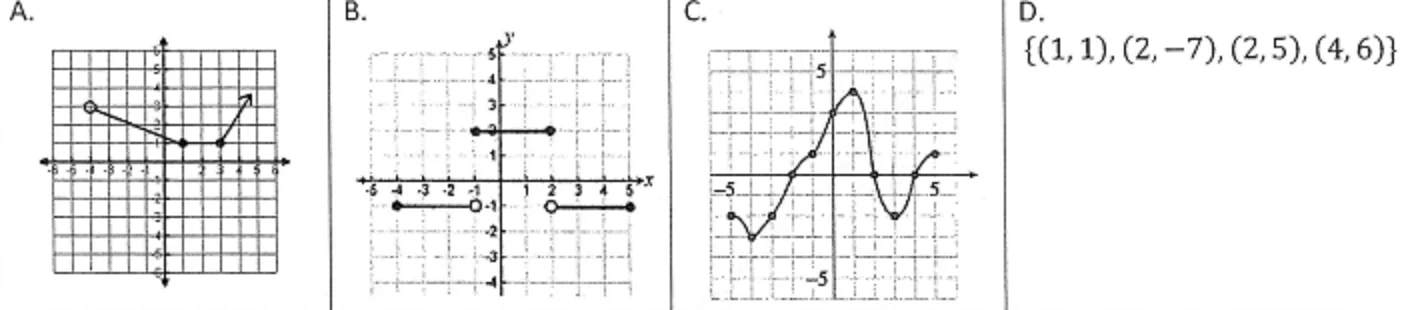
    For the following relations, fill in the table.
    ImageDomainRangeSolveIs this relation a function?
    AD =-Find xx if f(x)=1f(x)=1
    BD =R =f(2)=f(2) =
    C-R =f−1(0)=f^{-1}(0) =
    DD =--
    Figure for the question
    Show solution
    ImageDomainRangeSolveIs this relation a function?
    AD = {x∈R, x>−4}\{x \in \mathbb{R},\ x > -4\}-{x∈R, 1≤x≤3}\{x \in \mathbb{R},\ 1 \leq x \leq 3\}Yes
    BD = {x∈R, −4≤x≤5}\{x \in \mathbb{R},\ -4 \leq x \leq 5\}R = {−1,2}\{-1, 2\}f(2)=2f(2) = 2Yes
    C-R = {y∈R, −3≤y≤4}\{y \in \mathbb{R},\ -3 \leq y \leq 4\}f−1(0)=−2,2,or4f^{-1}(0) =-2, 2, or 4Yes
    DD = {1,2,4}\{1, 2, 4\}--No
    Worked solution
  2. Functions & Transformations

    State the domain of f(x)=3−x−2f(x) = \dfrac{3}{-x-2}. D = _____
    Show answer
    {χ∈R, χ≠−2}\{\chi \in \mathbb{R},\ \chi \neq -2\}
  3. Functions & Transformations

    State the domain of f−1(x)f^{-1}(x), if f(x)=−3(x−9)2−5f(x) = -3(x-9)^2 - 5. D = _____
    Show answer
    Range of f(x)f(x) is {y∈R, y≤−5}\{y \in \mathbb{R},\ y \leq -5\} Therefore, the domain of f−1(x)f^{-1}(x) is {χ∈R, χ≤−5}\{\chi \in \mathbb{R},\ \chi \leq -5\}
  4. Rational Expressions

    Factor fully. x2+2xy+y2−z2−2z−1x^{2} + 2xy + y^{2} - z^{2} - 2z - 1
    Show answer
    =x2+2xy+y2−(z2+2z+1)= x^{2} + 2xy + y^{2} - (z^{2} + 2z + 1) =(x+y)2−(z+1)2= \left(x + y\right)^{2} - \left(z + 1\right)^{2} =(x+y−z−1)(x+y+z+1)= \left(x + y - z - 1\right)\left(x + y + z + 1\right)
  5. Rational Expressions

    Simplify the following, show all your work. State restrictions if necessary. 4x6x2+7x−3−5x2x2+15x+18\dfrac{4x}{6x^2+7x-3} - \dfrac{5x}{2x^2+15x+18}
    Show solution
    =4x(2x+3)(3x−1)−5x(x+6)(2x+3)= \frac{4x}{(2x+3)(3x-1)} - \frac{5x}{(x+6)(2x+3)} =4x(x+6)−5x(3x−1)(2x+3)(3x−1)(x+6)= \frac{4x(x+6) - 5x(3x-1)}{(2x+3)(3x-1)(x+6)} =4x2−24x−15x2+5x(2x+3)(3x−1)(x+6)= \frac{4x^2 - 24x - 15x^2 + 5x}{(2x+3)(3x-1)(x+6)} =−11x2−21x(2x+3)(3x−1)(x+6)= \frac{-11x^2 - 21x}{(2x+3)(3x-1)(x+6)} x≠−32,13,−6x \neq \dfrac{-3}{2}, \dfrac{1}{3}, -6
  6. Rational Expressions

    Simplify and state any restrictions on the variable. x−26x2−7x−5÷−3x2+6x3x2+7x−20+2x+34x2−12x+9\frac{x-2}{6x^2-7x-5} \div \frac{-3x^2+6x}{3x^2+7x-20} + \frac{2x+3}{4x^2-12x+9}
    Show solution
    =(x−2)(2x+1)(3x−5)÷−3x(x−2)(x+4)(3x−5)+2x+3(2x−3)2= \frac{(x-2)}{(2x+1)(3x-5)} \div \frac{-3x(x-2)}{(x+4)(3x-5)} + \frac{2x+3}{(2x-3)^2} =(x−2)(2x+1)(3x−5)×(x+4)(3x−5)−3x(x−2)+2x+3(2x−3)2= \frac{(x-2)}{(2x+1)(3x-5)} \times \frac{(x+4)(3x-5)}{-3x(x-2)} + \frac{2x+3}{(2x-3)^2} =(x+4)−3x(2x+1)+2x+3(2x−3)2= \frac{(x+4)}{-3x(2x+1)} + \frac{2x+3}{(2x-3)^2} =(x+4)(2x−3)2−3x(2x+1)(2x+3)−3x(2x+1)(2x−3)2= \frac{(x+4)(2x-3)^2 - 3x(2x+1)(2x+3)}{-3x(2x+1)(2x-3)^2} =(x+4) ⁣(4x2−12x+9)−3x ⁣(4x2+8x+3)−3x(2x+1)(2x−3)2= \frac{(x+4)\!\left(4x^2-12x+9\right) - 3x\!\left(4x^2+8x+3\right)}{-3x(2x+1)(2x-3)^2} =4x3+4x2−39x+36−12x3−24x2−9x−3x(2x+1)(2x−3)2= \frac{4x^3 + 4x^2 - 39x + 36 - 12x^3 - 24x^2 - 9x}{-3x(2x+1)(2x-3)^2} =−8x3−20x2−48x+36−3x(2x+1)(2x−3)2,  x≠0,2,−4,53,−12,32= \frac{-8x^3 - 20x^2 - 48x + 36}{-3x(2x+1)(2x-3)^2},\; x \neq 0, 2, -4, \frac{5}{3}, \frac{-1}{2}, \frac{3}{2}
  7. Quadratic Functions

    Express y=x2−5xy = x^2 - 5x in vertex form
    Show answer
    y=(x−52)2−254y = \left(x - \dfrac{5}{2}\right)^2 - \dfrac{25}{4}
  8. Quadratic Functions

    What is the equation of the axis of symmetry of the function y=2x2−7x−24y = 2x^2 - 7x - 24
    Show answer
    x=74x = \dfrac{7}{4}
  9. Quadratic Functions

    Solve the linear-quadratic system. Express solution(s) in exact value. f(x)=3x2+17x+16f(x) = 3x^2 + 17x + 16 g(x)=−x−2g(x) = -x - 2
    Show solution
    3x2+17x+16=−x−23x^2 + 17x + 16 = -x - 2 3x2+18x+18=03x^2 + 18x + 18 = 0 x2+6x+6=0x^2 + 6x + 6 = 0 x=−6±36−242x = \frac{-6 \pm \sqrt{36 - 24}}{2} x=−3±3x = -3 \pm \sqrt{3} x=−3+3,y=1−3x = -3 + \sqrt{3}, \quad y = 1 - \sqrt{3} x=−3−3,y=1+3x = -3 - \sqrt{3}, \quad y = 1 + \sqrt{3} ∴\therefore Points of intersections are (−3+3,  1−3)(-3+\sqrt{3},\; 1-\sqrt{3}) and (−3−3,  1+3)(-3-\sqrt{3},\; 1+\sqrt{3})
  10. Exponential Functions

    Evaluate the expression x−3yn\dfrac{x^{-3}}{y^n} for x=4,y=7,n=−2x = 4, y = 7, n = -2.
    1. 4964\dfrac{49}{64}
    2. 6449\dfrac{64}{49}
    3. 78\dfrac{7}{8}
    4. 3136
    Show answer
    a) 4964\dfrac{49}{64}
  11. Exponential Functions

    Which of the following is equivalent to the expression (a3b4)−2 ⁣(a−3b−5)−4\left(a^3 b^4\right)^{-2}\!\left(a^{-3}b^{-5}\right)^{-4}?
    1. a6b12a^6 b^{12}
    2. a12b15a^{12}b^{15}
    3. 1a6b12\dfrac{1}{a^6 b^{12}}
    4. 1a6b7\dfrac{1}{a^6 b^7}
    Show answer
    a) a6b12a^6 b^{12}
  12. Exponential Functions

    Which of the following is equivalent to the expression (z73z5)4\left(\dfrac{\sqrt[3]{z^7}}{\sqrt{z^5}}\right)^4?
    1. 1z3\dfrac{1}{\sqrt{z^3}}
    2. zz
    3. z435\sqrt[35]{z^4}
    4. 1z23\dfrac{1}{\sqrt[3]{z^2}}
    Show answer
    d) 1z23\dfrac{1}{\sqrt[3]{z^2}}
  13. Trigonometric Ratios

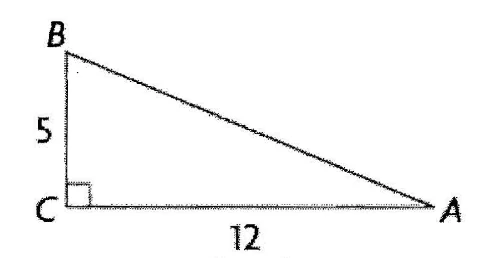
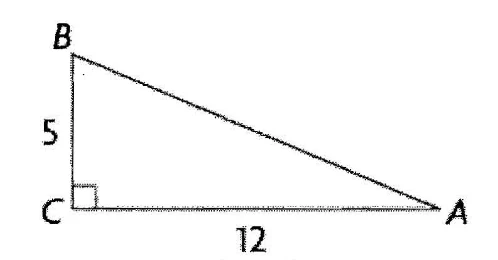
    Based on the figure, which of the following represents the length of ABAB?
    Figure for the question
    1. 12
    2. 13
    3. 14
    4. 15
    Show answer
    b) 13
  14. Trigonometric Ratios

    Based on figure 1, which of the following represents the trigonometry ratio of cot⁡(A)\cot(A)?
    Figure for the question
    1. 125\dfrac{12}{5}
    2. 1215\dfrac{12}{15}
    3. 513\dfrac{5}{13}
    4. 1412\dfrac{14}{12}
    Show answer
    a) 125\dfrac{12}{5}
  15. Trigonometric Ratios

    Based on figure 1, which of the following represents the measurement of angle BB to the nearest degree?
    Figure for the question
    1. 23∘23^\circ
    2. 21∘21^\circ
    3. 59∘59^\circ
    4. 67∘67^\circ
    Show answer
    d) 67∘67^\circ
  16. Trigonometric Functions

    Complete the following table.
    FunctionPeriodAmplitudePhase shiftVertical displacementRange
    y=3cos⁡(3x+180∘)−1y = 3\cos(3x + 180^\circ) - 1
    y=sin⁡34(2x+180∘)−1y = \sin\frac{3}{4}(2x + 180^\circ) - 1
    y=13cos⁡ ⁣(4x−90∘2)+3y = \frac{1}{3}\cos\!\left(4x - \frac{90^\circ}{2}\right) + 3
    y=‾cos⁡‾y = \underline{\quad} \cos \underline{\quad\quad}90∘90^\circ12\dfrac{1}{2}−60∘-60^\circ−3-3
    y=‾sin⁡‾y = \underline{\quad} \sin \underline{\quad\quad}720∘720^\circ3360∘60^\circN/A
    Show solution
    FunctionPeriodAmplitudePhase shiftVertical displacementRange
    y=3cos⁡(3x+180∘)−1y = 3\cos(3x + 180^\circ) - 1120∘120^\circ33−60∘-60^\circ−1-1{y∈R−4≤y≤2\left\{\begin{array}{l} y \in \mathbb{R} \\ -4 \leq y \leq 2 \end{array}\right.
    y=sin⁡34(2x+180∘)−1y = \sin\frac{3}{4}(2x + 180^\circ) - 1240∘240^\circ11−90∘-90^\circ−1-1{y∈R−2≤y≤0\left\{\begin{array}{l} y \in \mathbb{R} \\ -2 \leq y \leq 0 \end{array}\right.
    y=13cos⁡ ⁣(4x−90∘2)+3y = \frac{1}{3}\cos\!\left(4x - \frac{90^\circ}{2}\right) + 390∘90^\circ13\dfrac{1}{3}+11.25∘+11.25^\circ+3+3{y∈R83≤y≤103\left\{\begin{array}{l} y \in \mathbb{R} \\ \frac{8}{3} \leq y \leq \frac{10}{3} \end{array}\right.
    y=12cos⁡[2(x+60)]∘−3y = \frac{1}{2}\cos\left[2(x+60)\right]^\circ - 390∘90^\circ12\dfrac{1}{2}−60∘-60^\circ−3-3{y∈R−72≤y≤−52\left\{\begin{array}{l} y \in \mathbb{R} \\ -\frac{7}{2} \leq y \leq -\frac{5}{2} \end{array}\right.
    y=3sin⁡ ⁣[12(x−60)]∘y = 3\sin\!\left[\frac{1}{2}(x-60)\right]^\circ720∘720^\circ3360∘60^\circN/A{y∈R−3≤y≤3\left\{\begin{array}{l} y \in \mathbb{R} \\ -3 \leq y \leq 3 \end{array}\right.
  17. Trigonometric Functions

    How many x intercepts will the graph of the equation y=−2sin⁡θ−1y = -2\sin\theta - 1 from −360∘≤θ≤360∘-360^\circ \leq \theta \leq 360^\circ?
    Show solution
    0=−2sin⁡θ−10 = -2\sin\theta - 1 1=−2sin⁡θ1 = -2\sin\theta −12=sin⁡θ-\tfrac{1}{2} = \sin\theta ∴ −360∘≤θ≤360∘\therefore\ -360^\circ \leq \theta \leq 360^\circ ∴ θ1=−30∘  θ2=330∘\therefore\ \theta_1 = -30^\circ \; \theta_2 = 330^\circ θ3=210∘  θ4=−150∘\theta_3 = 210^\circ \; \theta_4 = -150^\circ There are 4 x-intercepts.
  18. Trigonometric Functions

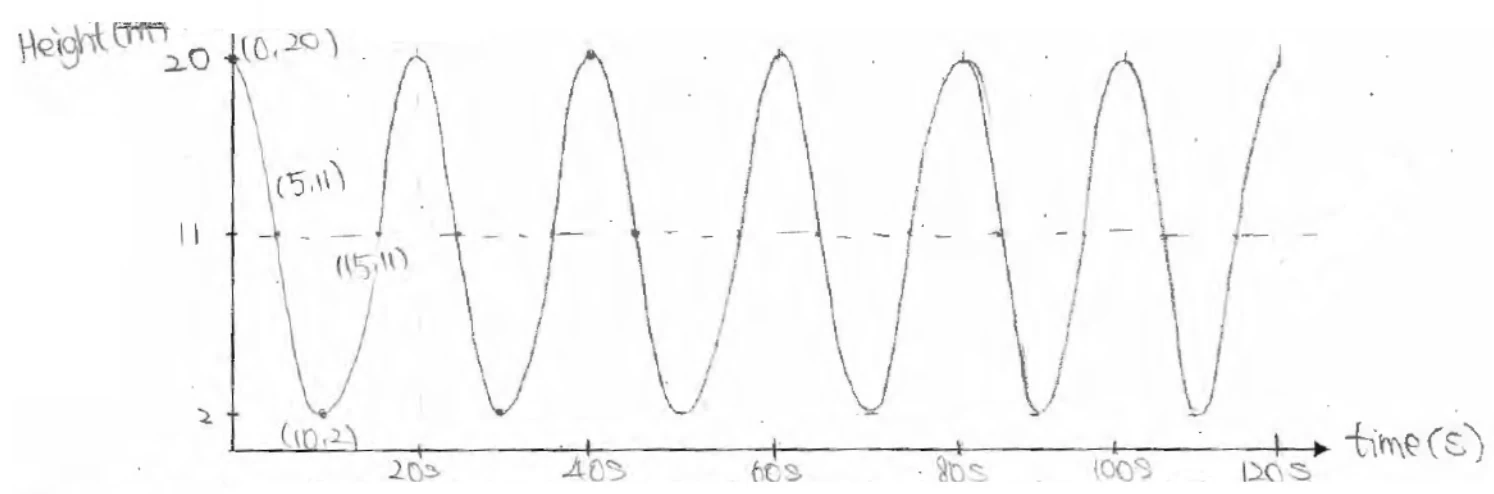
    A Ferris wheel at Charlotte's Amusement Park has a diameter of 18 m18\,\mathrm{m} and travels at a rate of 6 revolutions every 2 min. At the bottom of the ride, the passenger is 2 m2\,\mathrm{m} above the ground.
    1. Sketch the graph of the rider's height above the ground, in meters, verses the time, in seconds, for 2 minutes. Assume the rider starts at the highest position at t=0t = 0. Be sure to show the 5 major points of each period, the central axis, and the appropriate labels.
      Show solution
      A correct sketch has amplitude 99, midline h=11h=11, period 20 s20\,\mathrm{s}, and starts at the maximum point. Major points for one period are (0,20)(0,20), (5,11)(5,11), (10,2)(10,2), (15,11)(15,11), (20,20)(20,20). This pattern repeats every 20 s20\,\mathrm{s} for 0≤t≤1200 \leq t \leq 120.Worked solution
    2. Write the equation of the height that represents the height hh above the ground at time tt as a cosine function.
      Show answer
      h(t)=9cos⁡18t+11h(t) = 9\cos 18t + 11
    3. How high above the ground will the rider be at t=78 st = 78\,\mathrm{s}?
      Show solution
      h(78)=9cos⁡18⋅78+11h(78) = 9\cos 18 \cdot 78 + 11 h(78)=18.281152 mh(78) = 18.281152\,\mathrm{m} h(78)≈18.28 mh(78) \approx 18.28\,\mathrm{m} ∴\therefore the rider will be approximately 18.28 m18.28\,\mathrm{m} above the ground at t=78 st=78\,\mathrm{s}.
  19. Discrete Functions

    The fifth term in the sequence defined by t1=3t_1 = 3, tn=tn−1−4t_n = t_{n-1} - 4 is
    1. -5
    2. -9
    3. -13
    4. -17
    Show answer
    c) -13
  20. Discrete Functions

    The sum of the first eight terms of the arithmetic series where a=−6a = -6 and d=14d = \dfrac{1}{4} is
    1. -41
    2. -36.75
    3. -32.25
    4. -4.25
    Show answer
    a) -41
  21. Discrete Functions

    What is the 15th term of the arithmetic sequence that has t2=−8t_2 = -8 and t6=20t_6 =20?
    1. -7
    2. 83
    3. 81
    4. -71
    Show answer
    b) 83

Unit-by-Unit Checklist

Tick what you can do without notes. Anything you cannot tick, open the unit page and do its full free test.

Functions & Transformations

  • Use function notation, and state domain and range
  • Find the inverse of a function and graph it
  • Apply transformations with the mapping rule, in the right order

Rational Expressions

  • Simplify, multiply and divide radicals, and rationalize a denominator
  • Simplify rational expressions and state every restriction
  • Add and subtract rational expressions with a common denominator

Quadratic Functions

  • Move between standard, vertex and factored form
  • Find a maximum or minimum in a word problem
  • Use the discriminant to count roots
  • Solve a linear-quadratic system

Exponential Functions

  • Simplify with the exponent laws, including negative and rational exponents
  • Graph a transformed exponential function
  • Solve exponential equations with a common base
  • Model growth, decay and half-life

Trigonometric Ratios

  • Find exact values with special triangles and related angles
  • Use the sine and cosine laws, including the ambiguous case
  • Prove trig identities
  • Solve 2D and 3D triangle problems

Trigonometric Functions

  • Graph sine and cosine with amplitude, period, phase shift and vertical shift
  • Write the equation of a sinusoid from a graph
  • Model a periodic situation, like a Ferris wheel or tides

Discrete Functions

  • Find the general term of arithmetic and geometric sequences, and use recursion
  • Find the sum of arithmetic and geometric series
  • Expand binomials with Pascal's triangle
  • Solve simple interest, compound interest and annuity problems

MCR3U Exam Review FAQ

Is this a real MCR3U final exam?+

No. It is made only of the free questions on Martian Lab: three from each unit's free test, with their answers. The questions come from real Ontario unit tests, so the style is right, but your own final is written by your school.

How should I use this practice exam?+

Do it in one sitting, on paper, without notes. Mark it with the answers, then go to the unit page for every unit where you lost marks. Each one has the full free test for that unit.

What is on the MCR3U final exam?+

All of Grade 11 Functions: functions and transformations, rational expressions, quadratics, exponential functions, trig ratios, trig functions, and sequences, series and financial math. Your teacher decides the weighting.

Start Practicing

No credit card required to start.

Get started