Grade 12 IB Math is live, AA and AI · see the IB course

Grade 12 · MCV4U · Calculus & Vectors

MCV4U Final Exam Review: Free Practice Exam

Your MCV4U final is half calculus, half vectors, and it all counts. This practice exam pulls up to three questions from each unit's free test on Martian Lab, answers included. It is not a past exam paper. It is real practice, in the same style as the unit tests, mixed into one sitting. Then use the checklist to find the units you still need to fix.

Start the practice exam MCV4U formula sheet

Free MCV4U Practice Exam

24 questions (27 parts), up to 3 from each of the 8 units, taken from the free tests on Martian Lab. Do them in one sitting, on paper, then open the answers.

  1. Limits

    Determine lim⁡x→24\displaystyle\lim_{x \to 2} 4.
    Show answer
    44
  2. Limits

    Determine lim⁡x→23−x\displaystyle\lim_{x \to 2} 3^{-x}.
    Show answer
    19\dfrac{1}{9}
  3. Limits

    Determine lim⁡x→3f(x)\displaystyle\lim_{x \to 3} f(x), where f(x)={2x−4,x<32,x>3f(x) = \begin{cases} 2x-4, & x < 3 \\ 2, & x > 3 \end{cases}.
    Show answer
    22
  4. Derivatives

    Differentiate the following. Leave answers in simplified form with positive exponents only.
    1. f(x)=3x4+2xf(x) = \sqrt{3}x^4 + \dfrac{2}{\sqrt{x}}
      Show answer
      f(x)=3x4+2x=3 x4+2x−1/2f(x) = \sqrt{3}x^4 + \dfrac{2}{\sqrt{x}} = \sqrt{3}\, x^4 + 2x^{-1/2} f′(x)=43 x3−x−3/2f'(x) = 4\sqrt{3}\, x^3 - x^{-3/2} =43 x3−1x5/2= 4\sqrt{3}\, x^3 - \dfrac{1}{x^{5/2}}
    2. y=(7x2+1)3(2−5x)7y = (7x^2 + 1)^3(2 - 5x)^7
      Show solution
      y′=3(7x2+1)2⋅14x⋅(2−5x)7+(7x2+1)3⋅7(2−5x)6(−5)y' = 3(7x^2{+}1)^2 \cdot 14x \cdot (2{-}5x)^7 + (7x^2{+}1)^3 \cdot 7(2{-}5x)^6(-5) =(7x2+1)2(2−5x)6[42x(2−5x)−35(7x2+1)]= (7x^2{+}1)^2(2{-}5x)^6\bigl[42x(2{-}5x) - 35(7x^2{+}1)\bigr] =(7x2+1)2(2−5x)6(−455x2+84x−35)= (7x^2{+}1)^2(2{-}5x)^6(-455x^2{+}84x{-}35) =−7 (7x2+1)2(2−5x)6(65x2−12x+5)= -7\,(7x^2{+}1)^2(2{-}5x)^6(65x^2{-}12x{+}5)
  5. Derivatives

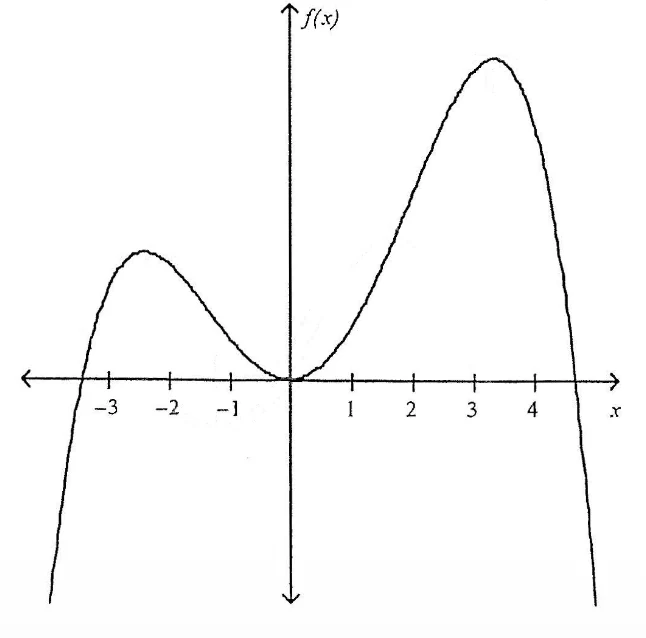
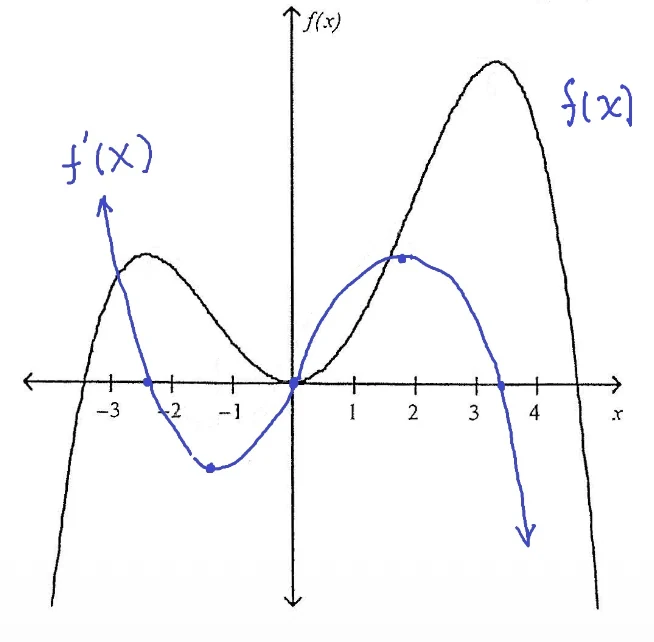
    Given the graph of y=f(x)y=f(x), give a rough sketch of the graph of y=f′(x)y=f'(x).
    Figure for the question
    Show solution
    Rough sketch of y=f′(x)y=f'(x).Worked solution
  6. Derivatives

    If f(x)=2x10f(x) = 2x^{10}, what is f(10)(x)f^{(10)}(x)?
    Show solution
    f′(x)=2×10 x9f'(x) = 2 \times 10\, x^9 f′′(x)=2×10×9⋅x8f''(x) = 2 \times 10 \times 9 \cdot x^8 f3(x)=2×10×9×8⋅x7f^3(x) = 2 \times 10 \times 9 \times 8 \cdot x^7 ∴  f(10)(x)=2×10×9×8×7⋯1 x0\therefore\; f^{(10)}(x) = 2 \times 10 \times 9 \times 8 \times 7 \cdots 1\, x^0 =2×10!= 2 \times 10!
  7. Curve Sketching

    Given f(x)=x−4x2−x−2f(x) = \dfrac{x-4}{x^2-x-2}, complete the following over its entire domain. State the equation of the vertical asymptote(s) and use limits to analyze the behaviours of f(x)f(x) near its vertical asymptote.
    Show solution
    V.A.: x=2 , x=−1V.A. :\ x = 2\ ,\ x = -1 lim⁡x→2+f(x)=−∞\displaystyle\lim_{x \to 2^+} f(x) = -\infty lim⁡x→2−f(x)=+∞\displaystyle\lim_{x \to 2^-} f(x) = +\infty lim⁡x→−1+f(x)=+∞\displaystyle\lim_{x \to -1^+} f(x) = +\infty lim⁡x→−1−f(x)=−∞\displaystyle\lim_{x \to -1^-} f(x) = -\infty
  8. Curve Sketching

    Given f(x)=x−4x2−x−2f(x) = \dfrac{x-4}{x^2-x-2}, complete the following over its entire domain. State the equation of the horizontal asymptote and use limits to analyze the end behaviours of f(x)f(x)
    Show solution
    lim⁡x→∞x−4x2−x−2\displaystyle\lim_{x \to \infty} \dfrac{x-4}{x^2-x-2} =lim⁡x→∞x2 ⁣(1x−4x2)x2 ⁣(1−1x−2x2)\displaystyle= \lim_{x \to \infty} \dfrac{x^2\!\left(\dfrac{1}{x} - \dfrac{4}{x^2}\right)}{x^2\!\left(1 - \dfrac{1}{x} - \dfrac{2}{x^2}\right)} =lim⁡x→∞01\displaystyle= \lim_{x \to \infty} \dfrac{0}{1} =0= 0 ∴ H.A is y=0\therefore\ H.A\ \text{is}\ y = 0 lim⁡x→∞f(x)=0+\lim_{x \to \infty} f(x) = 0^+ ∴ as x→∞, y→0 from above\therefore\ \text{as}\ x \to \infty,\ y \to 0\ \text{from above} lim⁡x→−∞f(x)=0−\lim_{x \to -\infty} f(x) = 0^- ∴ as x→−∞, y→0 from below\therefore\ \text{as}\ x \to -\infty,\ y \to 0\ \text{from below}
  9. Curve Sketching

    Given f(x)=x−4x2−x−2f(x) = \dfrac{x-4}{x^2-x-2}, complete the following over its entire domain. Locate all critical points. You may round to 1 decimal places.
    Show solution
    f′(x)=1⋅(x2−x−2)−(x−4)(2x−1)(x2−x−2)2f'(x) = \dfrac{1\cdot(x^2-x-2)-(x-4)(2x-1)}{(x^2-x-2)^2} =x2−x−2−2x2+9x−4(x2−x−2)2= \dfrac{x^2-x-2-2x^2+9x-4}{(x^2-x-2)^2} =−x2+8x−6(x2−x−2)2= \dfrac{-x^2+8x-6}{(x^2-x-2)^2} ∴ f′(x)=0\therefore\ f'(x)=0 x=−8±40−2x = \dfrac{-8 \pm \sqrt{40}}{-2} =4±10= 4 \pm \sqrt{10} x≈7.16or0.84x \approx 7.16 \quad \text{or} \quad 0.84
  10. Optimization

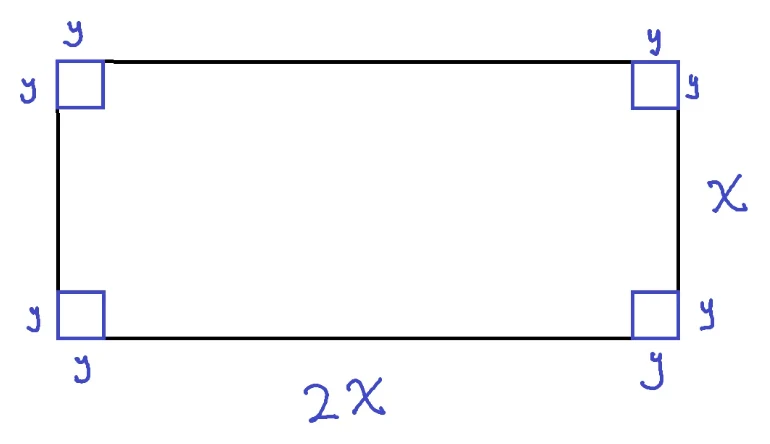
    You are given a piece of sheet metal that is twice as long as it is wide and has an area of 800 m2^2. Find the dimensions of the rectangular box that would contain a maximum volume if it were constructed from this piece of metal by cutting out squares of equal area at all four corners and folding up the sides. The box does not have a lid. Include a diagram with your setup/solution.
    Show solution
    Let xx be the width; 2x2x is the length. 2x⋅x=8002x \cdot x = 800 x2=400x^2 = 400 x=20x = 20 Let yy be the side length of the square that gets cut off. Maximize volume VV. V=(2x−2y)(x−2y)yV = (2x-2y)(x-2y)y =(40−2y)(20−2y)y= (40-2y)(20-2y)y =(800−120y+4y2)y= (800 - 120y + 4y^2)y =4y3−120y2+800y= 4y^3 - 120y^2 + 800y, where 0≤y≤100 \le y \le 10 v′=12y2−240y+800=0v' = 12y^2 - 240y + 800 = 0 3y2−60y+200=03y^2 - 60y + 200 = 0 y≈4.2y \approx 4.2 or y=15.7y = 15.7; reject y=15.7y = 15.7 since 0≤y≤100 \le y \le 10. V(0)=V(10)=0V(0) = V(10) = 0 V(4.2)=1540V(4.2) = 1540 (maximum) 20−8.4=11.620 - 8.4 = 11.6 40−8.4=31.640 - 8.4 = 31.6 ∴\therefore A box with dimensions 11.6 m×31.6 m×4.2 m11.6\text{ m} \times 31.6\text{ m} \times 4.2\text{ m} would yield the maximum volume.Worked solution
  11. Optimization

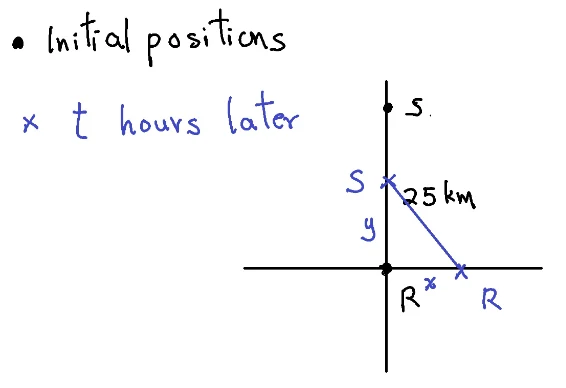
    A ship is 25 kilometres north of a raft when it started sailing south at a rate of 4 km/h and the raft started to drift east at a speed of 5 km/h. Determine the shortest distance between the ship and the raft. Include a diagram in your setup/solution.
    Show solution
    Let tt be the time in hours after the ship and raft start moving. Minimize distance dd. d=x2+y2d = \sqrt{x^2+y^2} x=5tx = 5t y=25−4ty = 25 - 4t 0≤t≤2540 \le t \le \dfrac{25}{4} d=(5t)2+(25−4t)2d = \sqrt{(5t)^2 + (25-4t)^2} =625−200t+41t2= \sqrt{625 - 200t + 41t^2} d′(t)=12(41t2−200t+625)−12⋅(82t−200)=0d'(t) = \dfrac{1}{2}\left(41t^2 - 200t + 625\right)^{-\frac{1}{2}} \cdot (82t - 200) = 0 t=20082=10041t = \dfrac{200}{82} = \dfrac{100}{41} d(0)=25d(0) = 25 d(6.25)=31.25d(6.25) = 31.25 d ⁣(10041)≈19.5d\!\left(\dfrac{100}{41}\right) \approx 19.5 ∴\therefore The minimum distance between the ship and the raft is about 19.5 km.Worked solution
  12. Optimization

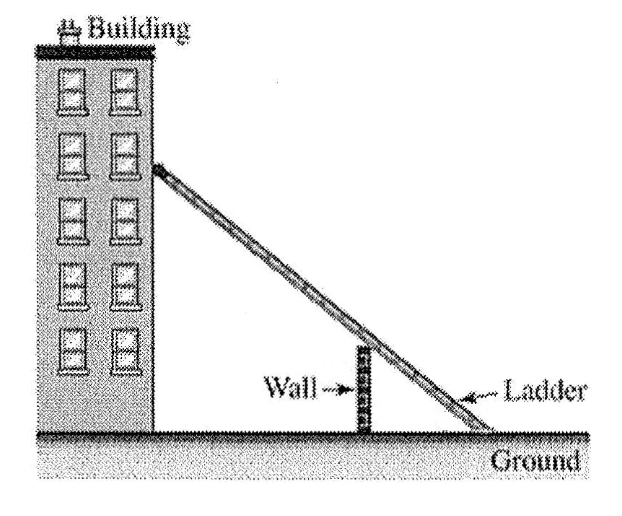
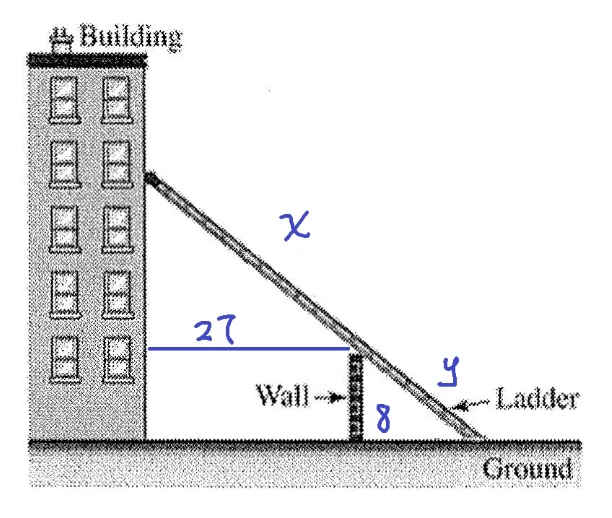
    A tall building is 27 m away from an 8 m wall that is parallel to it. A long ladder on the ground is to go over the wall and lean onto the building as shown. Determine the length of the shortest ladder that is required.
    Figure for the question
    Show solution
    Minimize the length of the ladder LL. Divide the length LL into two parts as shown in the diagram. L=x+yL = x + y Use similar triangles: y8=xx2−272\dfrac{y}{8} = \dfrac{x}{\sqrt{x^2 - 27^2}} y=8xx2−729y = \dfrac{8x}{\sqrt{x^2-729}} L=x+8xx2−729L = x + \dfrac{8x}{\sqrt{x^2-729}} L′(x)=(x2−729)3/2−5832(x2−729)3/2=0L'(x) = \dfrac{(x^2-729)^{3/2} - 5832}{(x^2-729)^{3/2}} = 0 (x2−729)3/2=5832(x^2 - 729)^{3/2} = 5832 x2−729=324x^2 - 729 = 324 x2=1053x^2 = 1053 x≈32.4x \approx 32.4 L≈46.9L \approx 46.9 ∴\therefore The minimum length of the ladder is about 46.9 m.Worked solution
  13. Derivatives of Trig, Exp and Log

    Is the derivative of a sinusoidal function always periodic? Explain why or why not with an example.
    Show solution
    The derivative of sin⁡(x)\sin(x) is cos⁡(x)\cos(x) and the derivative of cos⁡(x)\cos(x) is −sin⁡(x)-\sin(x). Both derivative functions are periodic. Since all sinusoidal functions can be expressed as sin⁡(x)\sin(x) or cos⁡(x)\cos(x), their derivative would also be periodic. y=tan⁡xy = \tan x, y′=sec⁡2xy' = \sec^2 x is also periodic.
  14. Derivatives of Trig, Exp and Log

    If f(x)=13e6x+4sin⁡(x)f(x) = \dfrac{1}{3}e^{6x} + 4\sin(x), find f′′ ⁣(π3)f''\!\left(\dfrac{\pi}{3}\right).
    Show solution
    f′(x)=13e6x⋅6+4cos⁡(x)=2⋅e6x+4cos⁡(x)f'(x) = \dfrac{1}{3}e^{6x} \cdot 6 + 4\cos(x) = 2 \cdot e^{6x} + 4\cos(x) f′′(x)=2e6x⋅6−4sin⁡(x)=12e6x−4sin⁡(x)f''(x) = 2e^{6x} \cdot 6 - 4\sin(x) = 12e^{6x} - 4\sin(x) f′′ ⁣(π3)=12⋅e2π−4⋅sin⁡ ⁣(π3)=12e2π−23f''\!\left(\dfrac{\pi}{3}\right) = 12 \cdot e^{2\pi} - 4 \cdot \sin\!\left(\dfrac{\pi}{3}\right) = 12e^{2\pi} - 2\sqrt{3}.
  15. Derivatives of Trig, Exp and Log

    Find the equation of the tangent line to the graph of f(x)=e−x2f(x) = e^{-\frac{x}{2}} that is perpendicular to the line x−2y−6=0x - 2y - 6 = 0. Express your answer in EXACT value.
    Show solution
    2y=x−62y = x - 6, y=12x−3y = \dfrac{1}{2}x - 3 ∴  m⊥=−2\therefore\; m_\perp = -2 f′(x)=e−x2⋅12=−2f'(x) = e^{-\frac{x}{2}} \cdot \dfrac{1}{2} = -2 e−x2=4e^{-\frac{x}{2}} = 4 −x2=ln⁡4\dfrac{-x}{2} = \ln 4 x=−2ln⁡4x = -2\ln 4 y=e−12(−2ln⁡4)=4y = e^{-\frac{1}{2}(-2\ln 4)} = 4 y=mx+by = mx + b 4=(−2)(−2ln⁡4)+b4 = (-2)(-2\ln 4) + b b=4−4ln⁡4b = 4 - 4\ln 4 ∴\therefore The equation of tangent is y=−2x+(4−4ln⁡4)y = -2x + (4 - 4\ln 4).
  16. Geometric Vectors

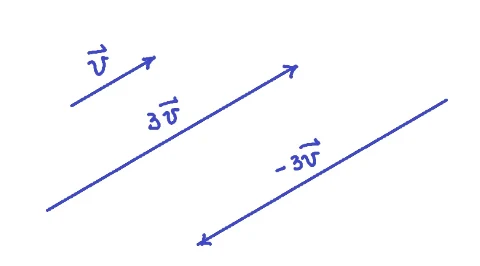
    Describe how the vectors 3v⃗3\vec{v} and −3v⃗-3\vec{v} are related v⃗\vec{v}. Include diagrams in your description.
    Show solution
    They are collinear or parallel. They have different magnitude. v⃗\vec{v} and 3v⃗3\vec{v} have the same direction. v⃗\vec{v} and −3v⃗-3\vec{v} have opposite directions.Worked solution
  17. Geometric Vectors

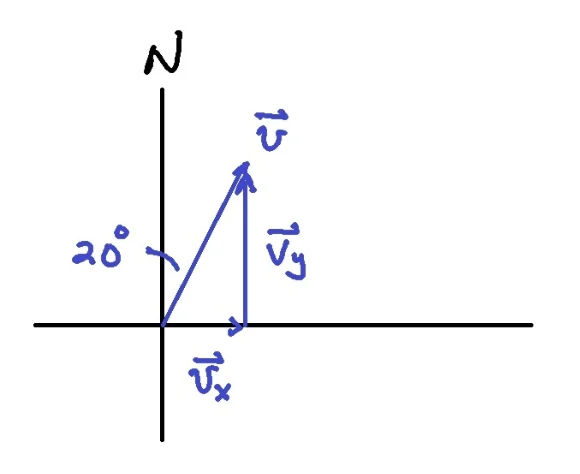
    Given v⃗=12 m/s\vec{v} = 12\,\text{m/s} at a bearing of 020∘020^{\circ}. What are the horizontal and vertical components, v⃗h\vec{v}_h and v⃗v\vec{v}_v respectively, of the vector?
    Show solution
    ∣v⃗y∣=12×sin⁡70∘|\vec{v}_y| = 12 \times \sin 70^{\circ} ≈11.28 m/s\approx 11.28\,\text{m/s} ∣v⃗x∣=12cos⁡70∘|\vec{v}_x| = 12 \cos 70^{\circ} ≈4.10 m/s\approx 4.10\,\text{m/s}Worked solution
  18. Geometric Vectors

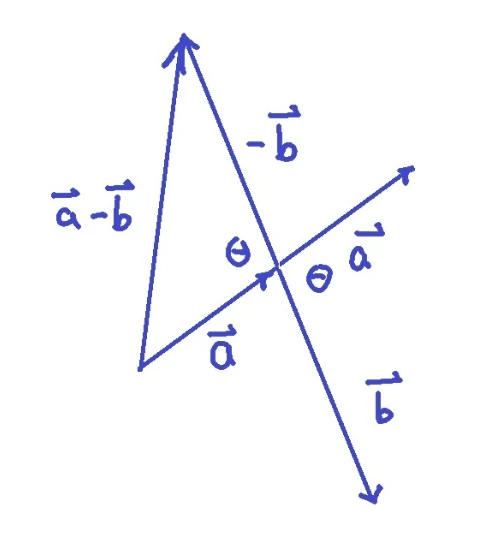
    Given ∣a⃗∣=8|\vec{a}| = 8, ∣b⃗∣=12|\vec{b}| = 12, and ∣a⃗−b⃗∣=10|\vec{a} - \vec{b}| = 10, determine the angle between the vectors a⃗\vec{a} and b⃗\vec{b} to the nearest degree. Include a diagram in your answer.
    Show solution
    ∣a⃗−b⃗∣2=∣a⃗∣2+∣b⃗∣2−2×∣a⃗∣ ∣b⃗∣cos⁡θ|\vec{a} - \vec{b}|^2 = |\vec{a}|^2 + |\vec{b}|^2 - 2 \times |\vec{a}|\,|\vec{b}|\cos\theta 100=64+144−2×8×12×cos⁡θ100 = 64 + 144 - 2 \times 8 \times 12 \times \cos\theta cos⁡θ=108192,  θ≈55.8∘\cos\theta = \dfrac{108}{192},\; \theta \approx 55.8^{\circ} ∴\therefore Angle between the two vectors is about 55.8∘55.8^{\circ}.Worked solution
  19. Cartesian Vectors

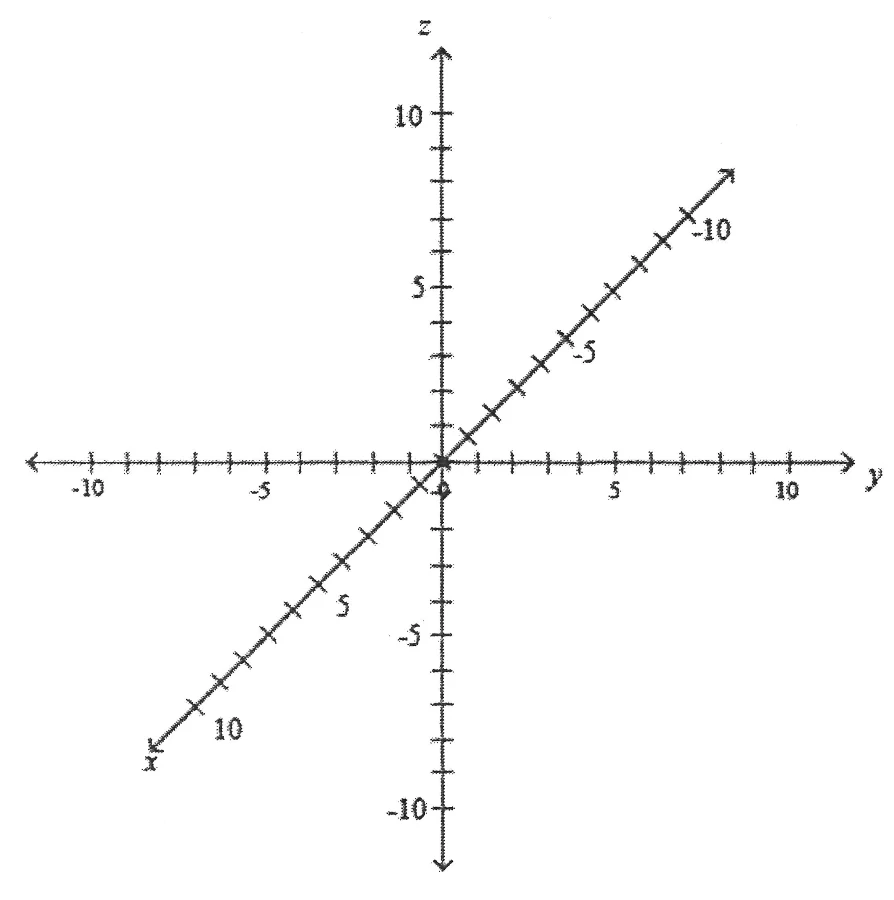
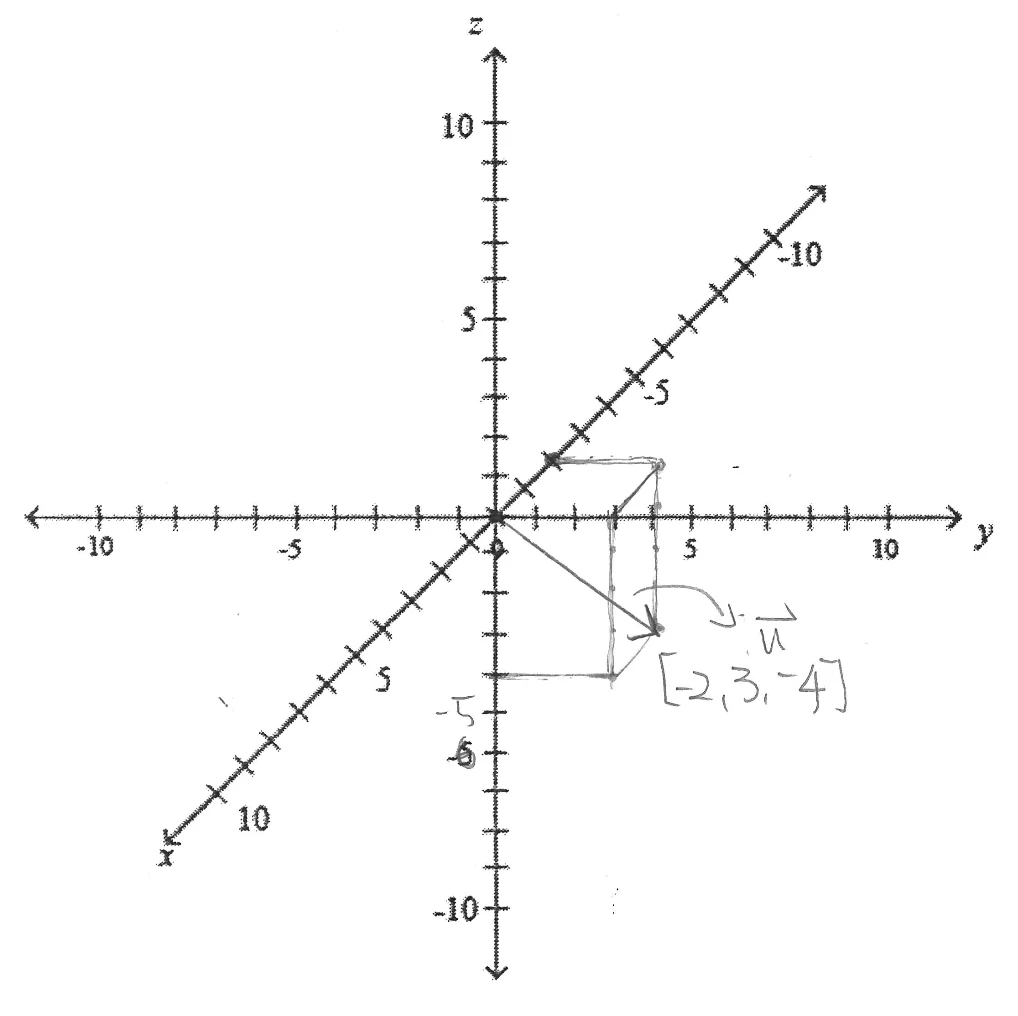
    Consider position vector u⃗=[−2,3,−4]\vec{u} = [-2, 3, -4],
    1. Draw u⃗\vec{u} by showing it with a prism.
      Figure for the question
      Show solution
      Worked solution
    2. Find the exact value of the magnitude of u⃗\vec{u}.
      Show answer
      ∣u⃗∣=(−2)2+(3)2+(−4)2|\vec{u}| = \sqrt{(-2)^2 + (3)^2 + (-4)^2} =4+9+16= \sqrt{4 + 9 + 16} =29= \sqrt{29}
    3. Find the unit vector that is in the direction of u⃗\vec{u}.
      Show answer
      1∣u⃗∣u⃗\dfrac{1}{|\vec{u}|}\vec{u} =129[−2,3,−4]= \dfrac{1}{\sqrt{29}}[-2, 3, -4] =[−229,329,−429]= \left[-\dfrac{2}{\sqrt{29}}, \dfrac{3}{\sqrt{29}}, -\dfrac{4}{\sqrt{29}}\right]
  20. Cartesian Vectors

    Given that u⃗=[−4,1,−8]\vec{u} = [-4, 1, -8] and v⃗=[8,−2,1]\vec{v} = [8, -2, 1], determine the angle between u⃗\vec{u} and v⃗\vec{v}.
    Show solution
    u⃗⋅v⃗=∣u⃗∣∣v⃗∣cos⁡θ\vec{u} \cdot \vec{v} = |\vec{u}||\vec{v}|\cos\theta cos⁡θ=u⃗⋅v⃗∣u⃗∣∣v⃗∣\cos\theta = \dfrac{\vec{u} \cdot \vec{v}}{|\vec{u}||\vec{v}|} =[−4,1,−8][8,−2,1]969= \dfrac{[-4, 1, -8][8, -2, 1]}{9\sqrt{69}} =−42969= \dfrac{-42}{9\sqrt{69}} θ=cos⁡−1 ⁣(−42969)\theta = \cos^{-1}\!\left(\dfrac{-42}{9\sqrt{69}}\right) ≐124.18∘\doteq 124.18^\circ ∣u⃗∣=(−4)2+(1)2+(−8)2|\vec{u}| = \sqrt{(-4)^2 + (1)^2 + (-8)^2} =9= 9 ∣v⃗∣=(8)2+(−2)2+(1)2|\vec{v}| = \sqrt{(8)^2 + (-2)^2 + (1)^2} =69= \sqrt{69} ∴ θ=124.18∘\therefore\ \theta = 124.18^\circ
  21. Cartesian Vectors

    Given u⃗=[2,−3,3]\vec{u} = [2, -3, 3] and v⃗=[3,1,4]\vec{v} = [3, 1, 4], determine the vector projection of v⃗\vec{v} onto u⃗\vec{u}.
    Show solution
    proj⁡u⃗v⃗=(v⃗⋅u⃗u⃗⋅u⃗)u⃗\operatorname{proj}_{\vec{u}}\vec{v} = \left(\dfrac{\vec{v} \cdot \vec{u}}{\vec{u} \cdot \vec{u}}\right)\vec{u} =[3,1,4][2,−3,3][2,−3,3][2,−3,3] [2,−3,3]= \dfrac{[3, 1, 4][2, -3, 3]}{[2, -3, 3][2, -3, 3]}\,[2, -3, 3] =1522 [2,−3,3]= \dfrac{15}{22}\,[2, -3, 3] =[1511,  −4522,  4522]= \left[\dfrac{15}{11},\; -\dfrac{45}{22},\; \dfrac{45}{22}\right] ∴ proj⁡u⃗v⃗=[1511,  −4522,  4522]\therefore\ \operatorname{proj}_{\vec{u}}\vec{v} = \left[\dfrac{15}{11},\; -\dfrac{45}{22},\; \dfrac{45}{22}\right]
  22. Lines and Planes

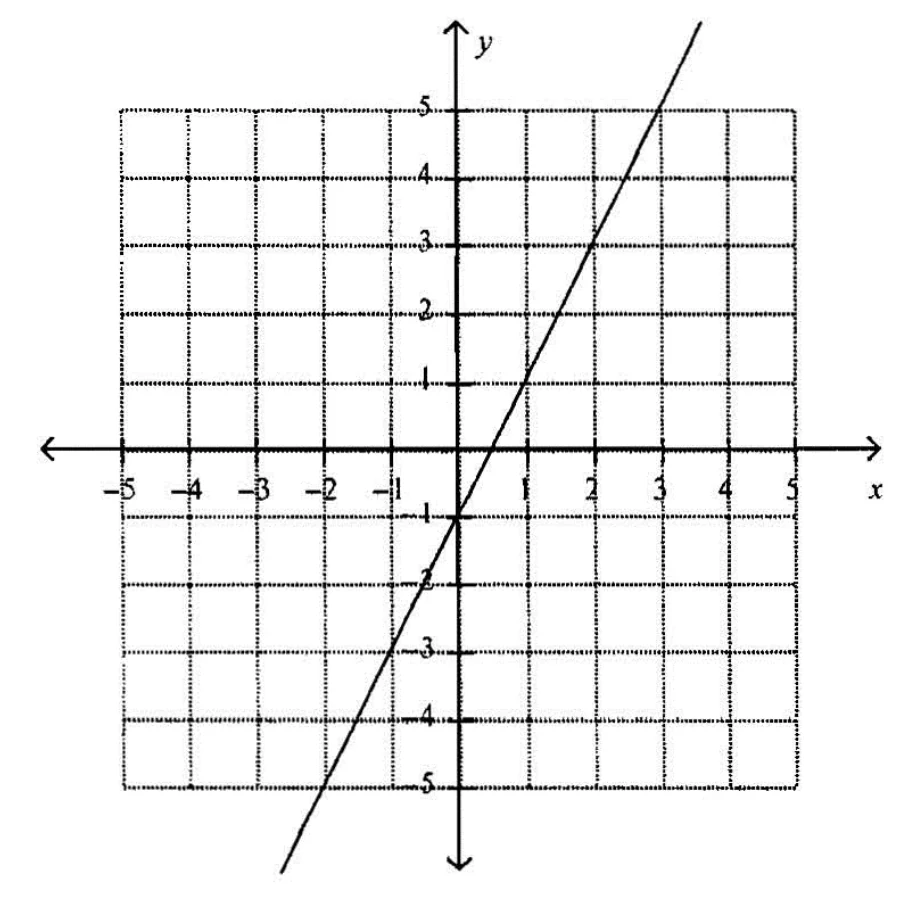
    Which vector equation represents the line perpendicular to the line shown?
    Figure for the question
    1. r⃗=(0,−1)+s ⁣(1,2),s∈R\vec{r} = \left(0,-1\right)+s\!\left(1,2\right), s \in \mathbf{R}
    2. r⃗=(0,−1)+s ⁣(−2,1),s∈R\vec{r} = \left(0,-1\right)+s\!\left(-2,1\right), s \in \mathbf{R}
    3. r⃗=(0,−1)+s ⁣(2,1),s∈R\vec{r} = \left(0,-1\right)+s\!\left(2,1\right), s \in \mathbf{R}
    4. none of these
    Show answer
    b) r⃗=(0,−1)+s ⁣(−2,1),s∈R\vec{r} = \left(0,-1\right)+s\!\left(-2,1\right), s \in \mathbf{R}
  23. Lines and Planes

    Which of the following is a direction vector for the line with scalar equation 3x+2y−1=03x +2y - 1 = 0?
    1. m⃗=[3,2]\vec{m} = [3,2]
    2. m⃗=[−2,3]\vec{m} = [-2,3]
    3. m⃗=[3,−2]\vec{m} = [3,-2]
    4. none of these
    Show answer
    b) m⃗=[−2,3]\vec{m} = [-2,3]
  24. Lines and Planes

    Which of the following vectors is perpendicular to the line passing through the points P ⁣(2,3)P\!\left(2,3\right) and Q ⁣(7,10)Q\!\left(7,10\right)?
    1. v⃗=[5,7]\vec{v} = [5,7]
    2. v⃗=[7,−5]\vec{v} = [7,-5]
    3. v⃗=[−3,2]\vec{v} = [-3,2]
    4. v⃗=[−10,7]\vec{v} = [-10,7]
    Show answer
    b) v⃗=[7,−5]\vec{v} = [7,-5]

Unit-by-Unit Checklist

Tick what you can do without notes. Anything you cannot tick, open the unit page and do its full free test.

Limits

  • Find average and instantaneous rates of change
  • Evaluate limits by factoring, rationalizing or common denominators
  • Find limits at infinity and one-sided limits
  • Decide where a piecewise function is continuous

Derivatives

  • Differentiate from first principles
  • Use the power, product, quotient and chain rules
  • Find the equation of a tangent or normal line
  • Use implicit differentiation, and position, velocity and acceleration

Curve Sketching

  • Find intervals of increase and decrease from the first derivative
  • Classify critical points with the first or second derivative test
  • Find concavity and points of inflection
  • Sketch a curve from its equation, and a function from its derivative's graph

Optimization

  • Set up the function to optimize, with its domain
  • Check critical numbers and endpoints for the absolute max or min
  • Solve related rates problems with the chain rule

Derivatives of Trig, Exp and Log

  • Differentiate exponential and logarithmic functions, including other bases
  • Differentiate sine, cosine and tangent with the chain rule
  • Solve growth, decay and periodic motion problems with derivatives

Geometric Vectors

  • Add and subtract vectors tip to tail
  • Find a resultant and its direction with the sine and cosine laws
  • Solve force and velocity problems, including the equilibrant

Cartesian Vectors

  • Work with vectors in components, in 2D and 3D
  • Use the dot product for angles, perpendicularity and projections
  • Use the cross product for normals, areas, work and torque
  • Write a vector as a linear combination, and test for coplanar vectors

Lines and Planes

  • Write lines in vector, parametric, symmetric and scalar form
  • Write planes in vector and scalar form
  • Find intersections of lines, a line and a plane, and two or three planes
  • Find distances from a point to a line or plane, and between skew lines

MCV4U Exam Review FAQ

Is this a real MCV4U final exam?+

No. It is made only of the free questions on Martian Lab: up to three from each unit's free test, with their answers. The questions come from real Ontario unit tests, so the style is right, but your own final is written by your school.

How should I use this practice exam?+

Do it in one sitting, on paper, without notes. Mark it with the answers, then go to the unit page for every unit where you lost marks. Each one has the full free test for that unit.

What is on the MCV4U final exam?+

Both halves of the course: limits, derivatives, curve sketching, optimization and the derivatives of trig, exponential and log functions, then geometric and Cartesian vectors, lines and planes. Your teacher decides the weighting.

Start Practicing

No credit card required to start.

Get started